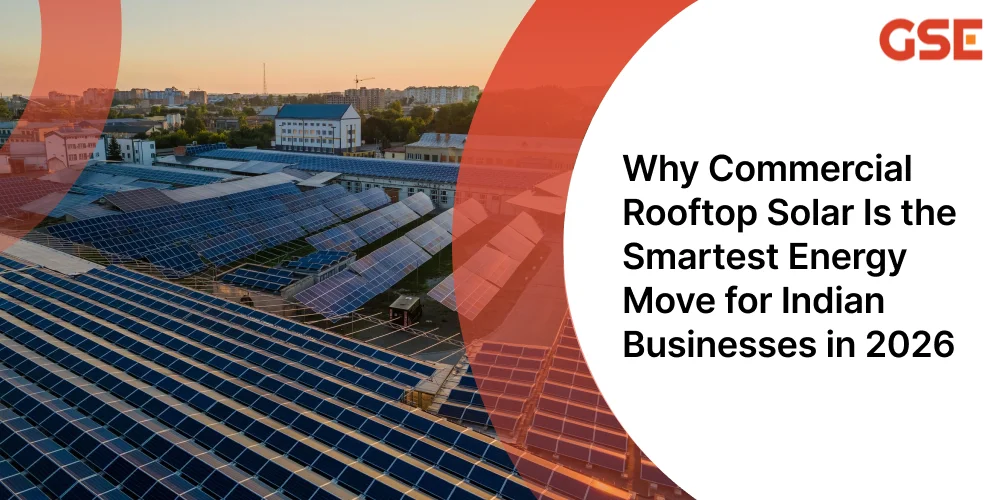
Why Commercial Rooftop Solar Is the Smartest Energy Move for Indian Businesses in 2025
Our Blogs
With a combined experience of over 250 years and the successful management of 30 MW of solar energy projects, GSER offers the most efficient solutions.

Why Commercial Rooftop Solar Is the Smartest Energy Move for Indian Businesses in 2025

Why Commercial Rooftop Solar Is the Smartest Energy Move for Indian Businesses in 2025 (1)
Talk To Us – We’re Here To Help

One of the rapidly increasing operational expenses of Indian businesses is electricity bills. Be it a factory in Pune, a logistics warehouse in Ahmedabad, a retail mall in Bengaluru, a hospital in Hyderabad or a corporate office in Mumbai, the electricity you get on the grid is becoming more and more expensive. And that price will just be increasing.

The equation is altered by commercial rooftop solar. Using your unused rooftop to create your own power plant and clean energy, your business will be able to produce its own power during the day, cut its monthly power bills drastically, receive financial incentives supported by the government, and show its clients and partners (as well as investors) that it possesses real sustainability credentials.

The installed rooftop solar capacity in India stands at more than 18 to 19 GW and commercial and industrial segment is the fastest expanding source of installed capacity. Not only are businesses in the various fields switching due to the fact that it is the right thing to do in the environment, but the financial argument is too deafening.

Both a beginner and an expert business decision-maker will find all the information needed in this guide: what commercial rooftop solar is, who it targets, what the benefits are, the process of installation, what are realistic costs, what are the ROI and the payback period, what is the financing model, what are the examples of capacity-sizing, and what are the real case studies. This is the only resource you need to read in case you are considering solar in your business.  

Ready to explore solar for your business?

GSE Renewables provides end-to-end commercial rooftop solar EPC services across India. Get a free site assessment and customised proposal for your facility.

Visit Commercial Rooftop Solar

10 Key Benefits of Commercial Rooftop Solar for Businesses

1. Significant Reduction in Electricity Bills

The most immediate and tangible benefit is the reduction in monthly electricity costs. A well-designed commercial solar system can offset between 40 and 80 percent of daytime power consumption from the grid. For a business paying Rs 8 per unit at 100 kW average consumption during working hours, that translates to savings of Rs 4 to 6 lakh per month, or Rs 48 to 72 lakh per year, on a well-sized system.

2. Protection Against Rising Tariffs

Commercial electricity tariffs in India have increased by 3 to 6 percent every year over the past decade, and that trend is expected to continue as grid infrastructure costs, fuel costs, and distribution losses are passed on to consumers. Solar locks in your energy cost for the next 25 years. The electricity your panels generate has a near-zero marginal cost, giving you a predictable, inflation-proof energy budget.

3. Strong Return on Investment

Commercial rooftop solar systems in India typically generate an annual ROI of 15 to 25 percent and achieve full payback within 3 to 5 years, after which the electricity generated is virtually free for the remaining 20 or more years of panel life. This makes commercial solar one of the highest-returning capital investments available to a business, outperforming most fixed deposits, bonds, and even equity markets in risk-adjusted terms.

4. Accelerated Depreciation Benefit

Under Section 32 of the Income Tax Act, businesses installing solar systems under the CAPEX model are eligible for accelerated depreciation at 40 percent in the first year. This means that the taxable income of the business is reduced significantly in the year of installation, providing a tax saving equivalent to 15 to 20 percent of the system cost, depending on the applicable corporate tax rate. This benefit is exclusive to CAPEX installations and is not available under the OPEX model.

5. Net Metering and Grid Export Credits

Under the net metering framework, any surplus electricity your system generates beyond on-site consumption is exported to the grid. The distribution company (DISCOM) credits this against your future import bills. In states with favourable net metering policies, businesses can zero out their electricity bill during low-consumption months and carry credits forward.

6. Improved Energy Independence and Reliability

Grid outages and voltage fluctuations disrupt production, spoil inventory, and damage equipment. Solar reduces dependence on the grid during the day, providing a stable and consistent power source. When paired with battery storage, solar systems can also provide emergency backup to critical loads.

7. Enhanced ESG Credentials and Corporate Sustainability

ESG (Environmental, Social, and Governance) reporting is increasingly mandatory for listed companies and expected by institutional investors, large customers in global supply chains, and government procurement bodies. Installing rooftop solar generates measurable greenhouse gas emission reductions that can be reported, certified, and communicated. A 500 kW system offsets approximately 700 to 750 tonnes of CO2 per year, the equivalent of planting over 30,000 trees annually.

8. Minimal Operational Disruption

Solar panels have no moving parts and require very little maintenance. Annual cleaning, periodic inverter health checks, and monitoring system reviews are all that is required. Annual O&M costs are typically Rs 300 to Rs 500 per kW, making them negligible relative to the savings generated.

9. Long System Life and Warranty Coverage

Quality solar panels carry a 25 to 30 year performance warranty, guaranteeing that panels will still generate at least 80 to 85 percent of their rated capacity at the end of that period. Inverters typically carry 5 to 10 year warranties. The system continues to generate value well beyond its payback period.

10. Increased Property Value

Commercial properties equipped with solar systems command higher valuations. The presence of an income-generating solar asset, with documented savings and remaining life, is increasingly factored into commercial real estate appraisals. For landlords and property developers, rooftop solar also creates a competitive advantage in leasing.

Want to know how much your business can save?

Use our free commercial solar assessment to get a customised savings estimate, system size recommendation, and payback projection for your facility.

Get a Free Assessment: gserenewables.com/service/commercial-rooftop-solar/

Commercial Rooftop Solar Cost in India: What to Expect in 2025

Cost is the first question most business decision-makers ask. The honest answer is that the cost of a commercial rooftop solar system in India depends on several factors, including system capacity, panel technology, mounting structure type, location, and local regulatory requirements. However, the current benchmarks are as follows:

Commercial Solar Cost Per kW (2025 Benchmarks)

System Capacity Estimated Cost Per kW Total System Cost Area Required
50 kW Rs 42,000 to Rs 50,000 Rs 21 to Rs 25 lakh Approx 400 sq.m.
100 kW Rs 38,000 to Rs 46,000 Rs 38 to Rs 46 lakh Approx 600 sq.m.
250 kW Rs 36,000 to Rs 44,000 Rs 90 to Rs 110 lakh Approx 1,500 sq.m.
500 kW Rs 34,000 to Rs 42,000 Rs 1.7 to Rs 2.1 crore Approx 3,000 sq.m.
1 MW Rs 32,000 to Rs 40,000 Rs 3.2 to Rs 4 crore Approx 6,000 sq.m.
Note: Costs vary based on panel brand (Tier 1 vs Tier 2), inverter type (string vs central), roof structure (RCC vs metal shed vs trapezoidal), civil work requirements, and state-specific logistics. GSE Renewables conducts detailed site assessments to provide accurate project-specific cost estimates.

For a detailed cost breakdown including panel brands, inverter costs, and state-wise variations, read our blog at gserenewables.com/blog/commercial-solar-installation-cost-india/ and gserenewables.com/blog/solar-panel-installation-cost-india/

What Factors Influence Commercial Solar Installation Cost?

  • System capacity: System capacity: Larger systems benefit from economies of scale, which reduces the per-kW cost significantly.
  • Panel technology: Panel technology: N-type TOPCon and monocrystalline PERC panels cost more per watt but deliver higher efficiency and better long-term returns per square metre of roof.
  • Roof type: Roof type: RCC flat roofs are the most straightforward and cost-effective. Metal-shed roofs with adequate load capacity also work well. Sloped or structurally compromised roofs may require additional civil engineering, adding to cost.
  • Inverter type: Inverter type: String inverters are standard for systems up to 500 kW. Central inverters are preferred for larger projects. Microinverters are used where shading is a concern.
  • Location: Location: Transport, labour rates, and DISCOM-specific approval processes vary across states, influencing the overall cost.
  • Monitoring and O&M: Monitoring and O&M: Comprehensive SCADA monitoring and multi-year O&M contracts add to total project cost but reduce operational risk and maximise lifetime generation.

Annual Maintenance Cost

For commercial rooftop solar systems, annual O&M costs in India are typically between Rs 300 and Rs 500 per kW, or approximately Rs 7 to Rs 10 lakh per MW per year. This covers module cleaning, routine electrical inspections, inverter health checks, and performance reporting.

Commercial Rooftop Solar ROI and Payback Period: Real Numbers

The financial case for commercial rooftop solar in India is compelling and well-documented. Here is a worked example for a 250 kW system installed on a factory in Maharashtra:

250 kW System Financial Model (Illustrative)

Parameter Value
System Capacity 250 kW
Estimated Annual Generation 3,50,000 to 3,75,000 units (kWh)
Applicable Grid Tariff Rs 8.50 per unit (industrial tariff)
Estimated Annual Savings Rs 29.75 to Rs 31.88 lakh
Total System Cost (CAPEX) Rs 95 to Rs 105 lakh
Accelerated Depreciation Benefit (40%) Rs 14 to Rs 16 lakh (Year 1 tax saving)
Net Effective Project Cost After AD Rs 79 to Rs 89 lakh
Simple Payback Period 2.5 to 3.5 years
25-Year Lifetime Savings (pre-escalation) Rs 7.5 to Rs 8 crore
Estimated ROI 18 to 22 percent per year
The above figures are illustrative and based on prevailing 2025 solar tariffs and industrial electricity rates. Actual savings and payback vary depending on your specific energy tariff, system capacity, location, solar irradiance, and financing model. Contact GSE Renewables for a site-specific financial model.

Impact of Electricity Tariff Escalation on ROI

The above model assumes a flat electricity tariff for simplicity. In reality, commercial and industrial tariffs in India have escalated at 4 to 6 percent per year historically. If you apply a conservative 5 percent annual escalation, the 25-year lifetime savings on a 250 kW system increase significantly, often doubling the baseline projection. This tariff escalation protection is one of the most powerful, and most underappreciated, financial arguments for going solar now rather than later.

CAPEX vs OPEX: Choosing the Right Financing Model for Your Business

One of the most important decisions for a business going solar is how to finance the system. Two primary models are available in India: CAPEX (Capital Expenditure) and OPEX (Operational Expenditure or Power Purchase Agreement). A third option, Deferred CAPEX, bridges the two.
Feature CAPEX OPEX / PPA Deferred CAPEX
System Ownership Business Developer (GSE) Business (after payoff)
Upfront Investment Full (or loan-funded) Zero Minimal / structured
Long-Term Savings Highest Moderate High
Accel. Depreciation Yes (40%) No Yes (post-ownership)
O&M Responsibility Business (or contract) Developer Business (or contract)
Best For Capex-ready businesses Zero-investment approach SMEs and growing firms
GSE Renewables supports all three financing models and works with clients to determine the optimal structure based on their financial position, tax situation, and operational goals. Our team provides clear financial modelling for each option before you make a decision.

Government Incentives and Accelerated Depreciation for Commercial Solar

Accelerated Depreciation Under Section 32 of the Income Tax Act

The most significant financial incentive for commercial solar in India is the Accelerated Depreciation (AD) benefit under the Income Tax Act. Businesses that install solar systems under the CAPEX model can claim 40 percent depreciation on the asset value in the first year. For a company in the 25 percent tax bracket installing a Rs 1 crore system, this translates to a direct tax saving of approximately Rs 10 lakh in Year 1. The effective net cost of the system is thus reduced by 10 to 20 percent depending on the corporate tax rate.

Grid-Connected Rooftop Solar Scheme (Phase II)

The Ministry of New and Renewable Energy (MNRE) operates the Grid-Connected Rooftop Solar Programme. While the subsidy component of this scheme is primarily designed for residential consumers, the programme creates favourable net metering regulations and DISCOM approval frameworks that benefit commercial and industrial rooftop solar installations across all states.

PM Surya Ghar Yojana

Launched in 2024, PM Surya Ghar Yojana is focused on residential rooftop solar. Commercial consumers are not directly eligible for subsidies under this scheme. However, the broader policy push it represents is accelerating state-level incentives, DISCOM net metering approvals, and financing access for the entire rooftop solar sector.

State-Level Incentives

Several Indian states offer additional incentives for commercial solar installations, including reduced wheeling and banking charges, property tax exemptions for solar-equipped buildings, and concessional financing through state renewable energy development agencies (SREDAs). States such as Gujarat, Rajasthan, Tamil Nadu, Maharashtra, Karnataka, and Telangana have particularly active commercial solar ecosystems with streamlined approval processes.
Note: While direct capital subsidies for commercial and industrial solar are limited compared to residential solar, the combination of accelerated depreciation, net metering, and competitive system costs means that commercial solar projects often deliver better financial returns than subsidised residential systems. The economics stand on their own.

Commercial Rooftop Solar Installation Process: A Step-by-Step Timeline

One of the concerns business owners often raise is the fear of operational disruption during installation. A well-executed commercial solar project is completed with minimal interference to day-to-day operations. Here is the step-by-step process that GSE Renewables follows for every commercial rooftop solar project:

Stage 1: Free Site Assessment and Feasibility Study (1 to 2 weeks)

Our engineering team conducts a detailed on-site assessment covering rooftop dimensions and structural load capacity, electrical load profile and consumption data, shading analysis using drone imaging or shadow simulation software, existing electrical infrastructure and grid connection point, and DISCOM-specific net metering eligibility. The output is a feasibility report with preliminary system design, estimated generation, projected savings, and payback period.

Stage 2: System Design and Technical Proposal (1 to 2 weeks)

Based on the feasibility study, our design team creates a customised solar plant design that includes panel layout, structural mounting details, single-line electrical diagram, shadow modelling, and projected annual energy generation (P50/P90 estimates). A detailed financial proposal is prepared, covering total project cost, financing options, ROI, payback period, and 25-year savings projection.

Stage 3: Approvals, Permits, and DISCOM Applications (2 to 6 weeks)

Our regulatory team handles all paperwork, including DISCOM application for grid connectivity and net metering, building department permit (where required), electrical inspector approvals, and State NODAL agency documentation. Timelines vary by state and DISCOM. GSE Renewables has deep experience navigating regulatory requirements across Maharashtra, Gujarat, Karnataka, Telangana, Rajasthan, Delhi, and other major states.

Stage 4: Procurement and Delivery (1 to 2 weeks)

High-quality solar modules, inverters, mounting structures, cables, protection equipment, and monitoring systems are procured from pre-qualified Tier 1 suppliers. GSE Renewables maintains strong relationships with leading panel manufacturers including Waaree, Vikram, Adani Solar, and LONGi, as well as inverter brands such as ABB, SMA, Delta, and Sungrow.

Stage 5: Civil Work and Panel Installation (1 to 4 weeks, depending on capacity)

Our trained installation teams carry out all civil and electrical work, including mounting structure installation, panel mounting and electrical connections, inverter and balance-of-system (BoS) installation, and cable tray laying and cable management. Work is conducted largely on the rooftop, with minimal disruption to ground-floor operations. Evening and weekend installation is arranged for clients with operational constraints.

Stage 6: Testing, Commissioning, and Grid Synchronisation (1 week)

The system undergoes comprehensive testing, including I-V curve testing of panels, insulation resistance testing, string current verification, inverter commissioning, and grid synchronisation. The system is commissioned in compliance with CEA standards and state DISCOM requirements.

Stage 7: Documentation, Training, and Handover

Complete as-built documentation, test reports, warranty certificates, and O&M manuals are provided at project handover. GSE Renewables also provides basic operation training to the client’s facility management team so they can monitor performance and escalate issues efficiently.

Stage 8: Ongoing O&M and Performance Monitoring

GSE Renewables offers comprehensive O&M packages, including remote performance monitoring via SCADA, scheduled preventive maintenance visits, reactive maintenance for equipment faults, and periodic performance reviews and generation reports. Our asset management services ensure your system performs at its peak for its entire operational life.

Why Choose GSE Renewables for Your Commercial Rooftop Solar Project?

GSE Renewables has been delivering commercial and industrial solar projects across India since 2016. With over 30 MW of successfully executed solar projects, a combined team experience of over 250 years in renewable energy, and a fully integrated CAPEX, OPEX, and deferred CAPEX delivery model, GSE Renewables is one of India’s most trusted commercial solar EPC partners.

What Sets GSE Renewables Apart

  • End-to-end EPC and turnkey execution: End-to-end EPC and turnkey execution: From site assessment and system design to DISCOM approvals, installation, commissioning, and O&M, GSE Renewables manages the entire process under a single contract.
  • Deep regulatory expertise: Deep regulatory expertise: Our team has navigated DISCOM approval processes in Maharashtra, Gujarat, Karnataka, Telangana, Rajasthan, Delhi, and other major states, ensuring smooth and fast-track project delivery.
  • Quality-first procurement: Quality-first procurement: We use only Tier 1 solar modules and inverters from bankable manufacturers, backed by manufacturer warranties and GSE Renewables’ own performance guarantee.
  • Flexible financing options: Flexible financing options: We support CAPEX, OPEX/PPA, and deferred CAPEX models and have strong relationships with NBFCs, green finance institutions, and international funding partners.
  • Asset management services: Asset management services: Post-commissioning, GSE Renewables provides remote monitoring, preventive maintenance, performance reporting, and long-term asset management for commercial clients.
  • Transparent project management: Transparent project management: Every project includes a dedicated project manager, regular progress updates, complete documentation, and a transparent cost management process.

See commercial and industrial solar projects

Explore the full portfolio of solar projects delivered by GSE Renewables across factories, warehouses, institutions, and commercial buildings across India.

View Our Projects

Frequently Asked Questions About Commercial Rooftop Solar

There is no regulatory minimum, but from a financial perspective, systems below 25 kW have higher per-kW costs and longer payback periods. For most commercial businesses, a 50 kW to 100 kW system is the entry point that delivers compelling ROI. GSE Renewables can assess your building and recommend the optimal system capacity based on your roof area, electricity consumption, and budget.
A useful rule of thumb is approximately 100 square feet (9 to 10 sq.m) per kW for monocrystalline panels, or around 7 to 8 sq.m per kW for high-efficiency N-type panels. A 100 kW system therefore requires approximately 700 to 1,000 sq.m of usable shadow-free rooftop area. Obstructions such as water tanks, HVAC equipment, lift rooms, and solar shading from adjacent structures reduce usable area and must be accounted for in the site assessment.
No. Solar installation work is conducted primarily on the rooftop and does not require production or office operations to be suspended. There may be a brief planned shutdown of a few hours for the grid connection and net meter installation, which GSE Renewables coordinates with the client in advance to minimise impact on operations.
Solar panels continue to generate electricity in diffuse light conditions, though at reduced output compared to clear sunny days. During periods of low solar generation, your business draws the additional power required from the grid as normal. Over the course of a year, the energy model accounts for seasonal variation, and your annual savings projection already factors in monsoon months. India’s average solar irradiance, even in the cloudiest states, is sufficient to make commercial solar highly viable.
Yes, commercial solar systems are designed to be modular and scalable. Provided that additional roof space is available and the inverter and switchgear can accommodate the additional capacity, systems can be expanded in phases. GSE Renewables designs systems with future expansion in mind wherever possible, sizing the inverter and cable infrastructure to accommodate planned growth.
GSE Renewables provides a workmanship and installation warranty on all projects. Solar modules carry a 25 to 30 year performance warranty from Tier 1 manufacturers. Inverters carry 5 to 10 year manufacturer warranties. O&M contracts can be structured to include performance guarantees, ensuring that your system generates at least a specified number of units per year.

Take the First Step Towards Smarter, Cheaper, Greener Energy

Commercial rooftop solar is no longer a niche investment reserved for large corporations. It is a proven, financially sound, and practically straightforward solution for any Indian business with a significant electricity bill and an available rooftop. Whether you are a factory owner looking to slash your power costs, a facility manager under pressure to meet sustainability targets, or a CFO looking for a reliable infrastructure investment with strong returns, commercial rooftop solar delivers on all counts.

GSE Renewables is India’s trusted partner for commercial and industrial solar, with over 30 MW delivered, a full-stack investment model, and an experienced team that handles every aspect of your project from the first site assessment to long-term asset management.

Request a Free Site Assessment and Customised Commercial Solar Proposal

Get Your Free Commercial Solar Assessment

Our engineers will assess your site, model your savings, and provide a no-obligation proposal within 5 working days.

Get Free Assessment

View Recent Posts

Top 10 Best Solar Companies in India for 2026

Top 10 Best Solar Companies in India for 2026

Our Blogs With a combined experience of over 250 years and the successful management of 30 MW of solar energy projects, GSER offers the most efficient solutions. Top 10 Best Solar Companies in India for 2026 India is targeting 280 GW of solar capacity by...

Read More