What Is a Solar Power Purchase Agreement (PPA)? A Simple Guide for Indian Businesses
Aug 24
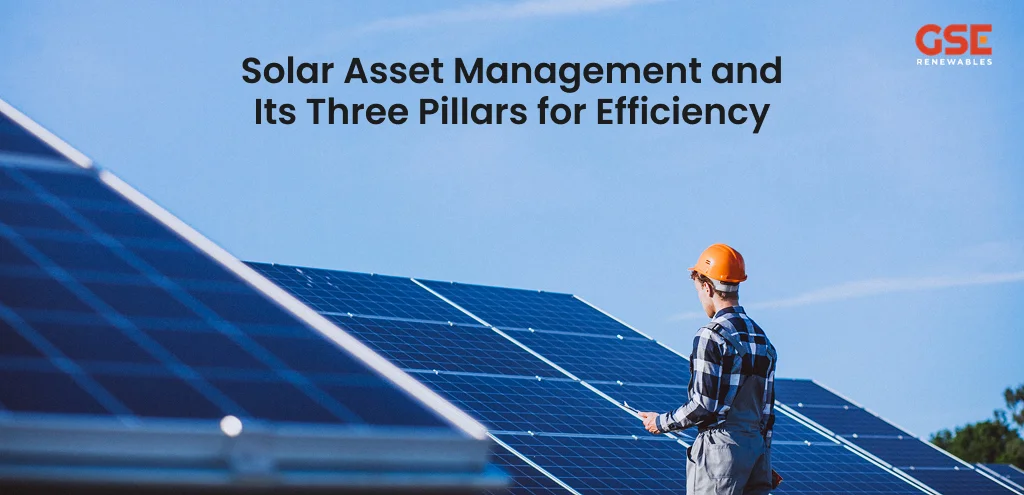
Solar asset management manages and tracks a physical asset like a solar plant, farm or site which is done through the operational stages of its lifecycle. Solar asset management ensures the flawless collection of all documents, data and life events of the asset.
Solar asset management is the active and ongoing practice of operating, maintaining and optimizing solar photovoltaic (PV) systems to optimize its performance and ROI. The rate at which solar power is growing is very high and a number of companies are putting solar panels on their roofs. Solar PV systems are long term investment and thus there should be a long term plan on how to maintain and operate the systems. Solar energy asset management can be used to ensure PV systems are operating at their peak efficiency and producing the most optimal return on investment.
At GSE Renewable Energy, we are the experts responsible to enhance the performance and reliability of your solar assets. Being one of the best solar companies in India, our end-to-end solar asset management services guarantee long term returns on your solar investment. As a commercial, industrial, or institutional energy user (offtaker), our solutions are customized to ensure your system is operating at maximum efficiency.
Our Solar Asset Management for Offtakers service is designed for businesses and institutions that rely on solar power but do not own or operate the solar assets themselves. GSE takes full responsibility for managing the performance, uptime, and reporting of your solar plant, so you can focus on your core business without worrying about energy output or operational hiccups.
Our solar asset management services will be a combination of technology and expertise that will guarantee all panels, inverters, and connections will function as intended. We offer an open and proactive performance analytics and warranty tracking that protects your investment.
Having a solid history of success in the industrial and commercial installations, GSE Renewable Energy remains the standard bearer among solar asset management firms in India. Collaborate with us and realize maximum potential of your solar systems effectively, dependably and in a sustainable manner.
One can understand that both the rooftop and ground mounted installations will contribute equally with an approximately maximum difference in percentage of 10% by taking a look at the worldwide trends of solar energy development in countries like the USA, Australia and Germany. In recent developments, it is seen that the countries which have more ground based capacity are doing rooftop plants and vice-versa. Each of the cell technologies have their own merits and demerits over the other types. One thing will continue to be a part of the process to effectively operate the already installed assets during the lifetime of the plant.
At GSE Renewable Energy, we believe that efficient solar asset management is the key to improving the performance and lifespan of solar power systems. As one of the top solar asset management companies in India, we anchor three essential pillars to deliver best results for your solar PV systems:
For any plant owner or offtaker, understanding how your solar system performs against its rated capacity is central to protecting your investment. Performance Ratio (PR) tracking is the single most reliable metric in solar asset management to measure real-world system efficiency against design specifications. A healthy PR typically ranges between 75% and 85%. Any consistent drop below that threshold is an early signal that something needs attention.
PR tracking in solar asset management does more than report a number. It identifies where your plant is losing energy and why. Common causes of PR degradation include soiling losses from dust accumulation, inverter inefficiencies, shading from nearby structures, module mismatch, and wiring degradation. When these losses go undetected, they compound quietly over months and significantly reduce your cumulative energy generation and revenue.
At GSE Renewables, our solar asset management platform benchmarks your plant’s PR continuously and flags deviations in real time. This means your team receives an alert the moment performance slips outside acceptable bounds, not weeks later when the losses have already accumulated.
Fault detection is the proactive layer of solar asset management that prevents small electrical or mechanical issues from becoming costly unplanned shutdowns. Traditional manual inspections, typically conducted monthly or quarterly, often miss faults in the days or weeks between visits. Modern fault detection systems integrated within solar asset management platforms monitor string-level current, inverter output, module temperature differentials, and grid synchronization in real time.
Key fault types detected through continuous monitoring include the following. String faults occur when one or more strings in an array produce significantly lower current than adjacent strings, pointing to bypassed cells, damaged connectors, or partial shading. Inverter faults are detected through abnormal output waveforms, overheating signals, or communication drops. Ground faults are identified through insulation resistance monitoring, which is critical for both safety and system integrity. Clamp and connector faults show up as localized hotspots when combined with thermal imaging during scheduled inspections.
For plant owners managing 1 MW solar power plants and above, the cost of a single undetected inverter fault over a 30-day period can represent tens of thousands of rupees in lost generation revenue. This is precisely why automated fault detection is not an optional upgrade in solar asset management but a core requirement for ROI protection.
|
GSE Renewables Uptime Benchmark: Our managed solar plants maintain an average system availability of over 98.5%, compared to the industry average of 94 to 96% for unmanaged plants. This uptime improvement directly translates into higher energy generation, better PPA compliance, and stronger ROI across the asset lifecycle. |
Effective maintenance planning is the operational backbone of solar asset management. Without a structured O&M schedule, plant owners face reactive maintenance cycles where issues are addressed only after they cause generation losses. Proactive maintenance planning eliminates this pattern by scheduling interventions before faults develop, distributing workload efficiently across the plant’s operational calendar, and documenting every activity for warranty and compliance purposes.
A well-designed O&M plan in solar asset management covers four categories of maintenance activity.
The following checklist is used by GSE Renewables as part of our structured solar asset management program. Plant owners and facility managers can use this as a reference framework to evaluate whether their current O&M process covers all critical maintenance touchpoints. For a customized version specific to your plant capacity and location, contact GSE Renewables here.
|
Category |
O&M Task |
Frequency |
Priority |
|
Panel Cleaning |
Dry cleaning of panel surfaces to remove dust and particulate buildup |
Weekly / Fortnightly |
Critical |
|
Panel Cleaning |
Wet cleaning with deionized water and soft brushes for stubborn soiling |
Monthly |
High |
|
Inverter |
Check inverter display for error codes and warning flags |
Daily (Remote) |
Critical |
|
Inverter |
Physical inspection of cooling fans, ventilation filters, and enclosure seals |
Monthly |
High |
|
Inverter |
Full inverter servicing including firmware update and thermal scan |
Bi-annual |
High |
|
String and Array |
String current logging and comparison against baseline |
Weekly (Remote) |
Critical |
|
String and Array |
Thermal imaging of string combiner boxes and junction boxes |
Quarterly |
High |
|
Cabling |
Visual inspection of DC and AC cable runs for physical damage |
Monthly |
High |
|
Cabling |
Insulation resistance (IR) testing across DC string circuits |
Bi-annual |
Critical |
|
Mounting Structure |
Check mounting hardware for corrosion, loosening, or physical damage |
Quarterly |
Medium |
|
Monitoring System |
Verify data logger connectivity and data transmission accuracy |
Weekly (Remote) |
Critical |
|
Monitoring System |
Reconcile generation data against irradiance sensor readings |
Monthly |
High |
|
Earthing |
Earth continuity and ground resistance testing |
Annual |
Critical |
|
Lightning Protection |
Inspect surge protection devices (SPDs) and earthing strips |
Annual |
High |
|
Vegetation |
Clear vegetation overgrowth that may cause shading or fire risk |
Quarterly |
Medium |
|
Documentation |
Update O&M log, warranty register, and compliance records |
Monthly |
High |
|
Performance Review |
Full PR calculation, loss analysis, and performance report to plant owner |
Monthly |
Critical |
|
Want this checklist customized for your plant? GSE Renewables provides plant-specific O&M checklists, maintenance schedules, and performance benchmarks as part of our Solar Asset Management for Offtakers service. Get in touch with our team to receive a tailored O&M plan for your solar installation. |
Choosing the right monitoring approach is one of the most consequential decisions in solar asset management. The market offers a spectrum of options ranging from basic data loggers to enterprise-grade asset management platforms. Understanding the differences helps plant owners avoid underinvesting in monitoring infrastructure and suffering generation losses that exceed the cost of better tooling many times over.
|
Monitoring Feature |
Manual Inspection |
Basic SCADA / Logger |
GSE Asset Management Platform |
|
Real-Time Generation Data |
No |
Yes (plant level) |
Yes (string level) |
|
Automated Fault Alerts |
No |
Limited |
Yes, multi-level alerting |
|
PR Tracking and Reporting |
Manual / Periodic |
Basic export only |
Automated monthly reports |
|
Thermal Imaging Integration |
No |
No |
Yes, scheduled and on-demand |
|
Inverter Health Trending |
No |
Basic event logs |
Predictive trend analysis |
|
PPA and Compliance Reporting |
Manual |
Manual |
Automated and auditable |
|
Remote Diagnostics |
No |
Partial |
Full remote diagnostics |
|
O&M Scheduling Integration |
No |
No |
Yes, integrated ticketing |
|
ROI and Financial Analytics |
No |
No |
Yes, full financial dashboards |
|
Suitable Plant Size |
Small rooftop |
100 kW to 500 kW |
500 kW and above |
For plant owners operating 1 MW solar power plants or larger commercial installations, the difference between a basic logger and a managed asset management platform is not a matter of convenience. It is a direct financial decision. A managed platform with automated PR tracking and fault detection can recover 3 to 6% of annual generation that would otherwise be lost to undetected faults and deferred maintenance.
How Solar Asset Management Protects Your ROI
Every solar investment carries a financial model built on specific generation assumptions. Solar asset management is the operational discipline that ensures your plant delivers on those assumptions across its 20 to 25 year operational life. When asset management is weak or absent, the gap between projected and actual generation grows silently over time, eroding returns without any single obvious cause.
Is Your Solar Plant Performing at Its Full Potential?
If your solar plant is more than 12 months old and you have not conducted a formal performance review, there is a high probability that you are experiencing generation losses that have not been identified. Our free solar plant performance review at GSE Renewables covers the following.
|
Asset management in solar energy is experiencing a swift transformation backed by technological development and the increasing urgency of climate change. As the industry evolves, solar asset management platforms and solar asset management services are becoming essential factors for operational effectiveness and eco-friendly growth for solar PV assets.
To address the problems of managing solar PV assets using best practices is necessary for long lasting success. Key strategies include:
The future of solar asset management is evolving rapidly with new technologies shaping the way solar assets are observed and maintained. The use of solar asset management platforms and modern technologies like automation, machine learning and the internet of things is making huge improvements in execution and cost effectiveness.
At GSE Renewables, we understand the growing demand for environmentally friendly missions. Our solar asset management services are created with green practices and ESG (Environmental, Social and Governance) principles at their core. These practices align with global climate goals and appeal to investors who prioritize responsible sourcing and long-term environmental impact.
As the focus on climate change and sustainable energy intensifies, GSE remains committed to staying ahead of regulatory changes. We continuously update our strategies to ensure our solar PV assets remain compliant, efficient and future-ready.
GSE Renewables is one of the top companies in solar panel asset management. Our innovative asset management system helps increase the cost and performance of your solar investments allowing you to make smart decisions about your operations. With our system you get insights on energy production, track maintenance costs, detect malfunctions faster and monitor your solar assets remotely. All in one place. Learn more about our solar asset management services.
Solar asset management (SAM) is the process of handling economic, technical and operational components of solar energy projects. It guarantees that solar assets run efficiently, stay profitable and meet compliance standards. Effective SAM helps maximize returns on investment and supports the long-term success of solar projects, playing a key role in the global shift toward renewable energy. For plant owners managing large installations, explore our guide on 1 MW solar power plant operations for detailed capacity planning insights.
Absolutely. SAM supports sustainability by improving solar plant performance to deliver clean, renewable energy. When combined with environmental, social and governance (ESG) practices it further empowers the positive environmental influence of solar investments and attracts responsible, sustainability focused investors. To learn more about how GSE manages assets sustainably, visit our Solar Asset Management service page.
Talk to our solar asset management experts at GSE Renewables. Request your free performance review today.
Our Blogs With a combined experience of over 250 years and the successful management of 30 MW of solar energy projects, GSER offers the most efficient solutions. What Is a Solar Power Purchase Agreement (PPA)? A Simple Guide for Indian Businesses If you’ve sat through...
Read MoreOur Blogs With a combined experience of over 250 years and the successful management of 30 MW of solar energy projects, GSER offers the most efficient solutions. Group Captive Solar: The 26/51 Rule for Industrial Buyers Group captive solar enables two or more industrial consumers...
Read MoreOur Blogs With a combined experience of over 250 years and the successful management of 30 MW of solar energy projects, GSER offers the most efficient solutions. 1 kW Solar Panel Price, Units Per Day and Subsidy in India 2026 In 2026, Indian homes are...
Read More