What Is a Solar Power Purchase Agreement (PPA)? A Simple Guide for Indian Businesses
Aug 24
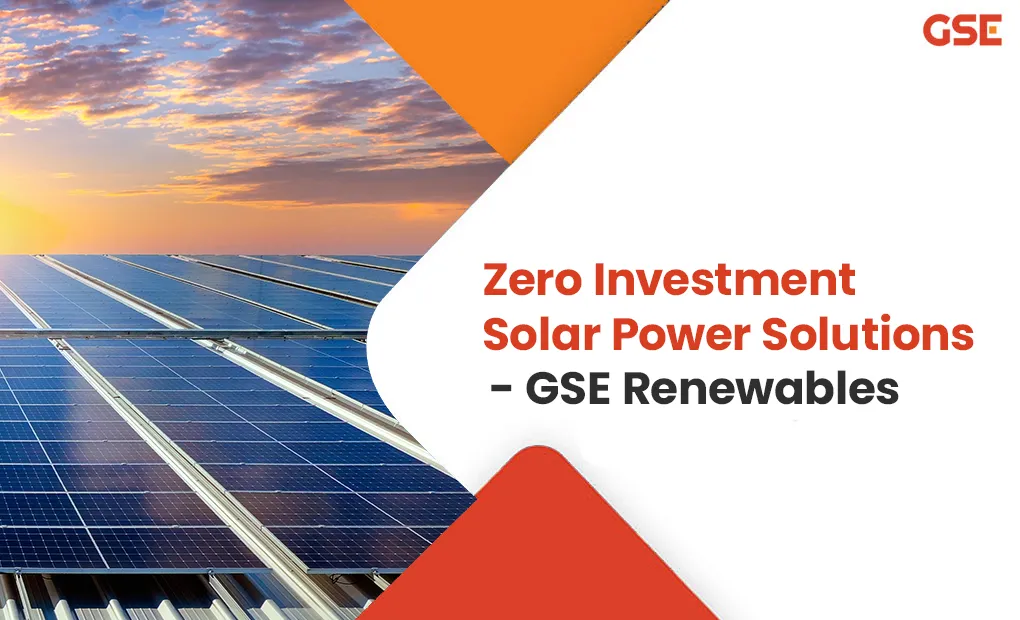
At GSE Renewables, it is our feeling that everybody must have an opportunity to invest in solar energy without the high initial cost. This is why we provide zero investment solar power plant solutions that enable you to easily switch to clean and sustainable energy. Our solar model with no upfront costs means that once you get the model, you will be able to begin to save on electricity bills. This paper will discuss the advantages of zero investment solar energy and how it can enable you to reduce costs and minimize your carbon footprint.
Zero investment solar power is an intelligent yet economical method of reducing the electricity bills to contribute to a cleaner environment. The concept of having solar panels installed on your rooftop or your property with zero upfront costs to generate your own electricity and reduce reliance on the power grid is a great idea. This will assist you to save money but also has a role to play in a more sustainable future.
The greatest benefit of selecting zero investment solar is that it does not require you to pay a huge sum of money to start. To individuals and businesses interested in investing in solar power, yet do not have the capital, our solutions make investing in solar power projects simple and affordable. All installation and maintenance is done by us, so you can experience the benefits of solar energy without any initial cost.
Zero investment solar power lets you have the benefits of solar energy without any initial payment. The investment in solar with no upfront cost is mounted on a rooftop or property using photovoltaic cells which convert sunlight into electricity. This clean & renewable energy supplies electricity to your business, helping companies to save electricity costs without depending on the traditional power grid.
The solar panels produce sunlight energy during the day. When your system makes more electricity than you consume, then any surplus power is returned to the grid via net metering in order to save the total cost of electricity.
You can still draw power at night or even on cloudy days at the grid but your overall usage and expenses will be greatly reduced. When you invest in a zero investment solar model, you will be less dependent on the old generation electricity and will pay less in your bills and will reduce your carbon footprint.
Install solar with no investment cost through flexible schemes tailored to your needs. Whether you are looking to reduce energy expenses or explore investment in solar panels, these zero-cost options make it easy to switch to clean energy. As investment in solar energy in India continues to rise, GSE offers three smart & affordable zero-investment models – BOOT (Build-Own-Operate-Transfer), PPA (Power Purchase Agreement) & OPEX model. These models let you adopt solar with no upfront cost, while enjoying long-term energy savings and sustainability. Our flexible solutions ensure maximum returns and energy independence without any financial stress.
The BOOT model operates under a Power Purchase Agreement (PPA) between the consumer & our investor team. As part of this agreement, the consumer agrees to purchase electricity generated by the solar plant at a predetermined tariff rate for the contract duration.
One of the key advantages of the BOOT model is that we handle all aspects of setting up the solar plant including design, engineering, procurement, installation & commissioning. This means the consumer faces zero investment for solar panel business in India and no operational hassles.
The consumer only pays for the electricity produced by the solar plant. If there is no power generation, no payment is required, meaning all performance risks are borne by our team. Additionally, we take full responsibility to operate & maintain the plant throughout the project term, ensuring zero overhead for the consumer.
The PPA price is typically 30 to 40% lower than the grid tariff which guarantees significant cost savings on electricity. The fixed price also protects the consumer against future increases in grid electricity rates, ensuring predictable savings & long-term benefits. At the end of the PPA term, the solar plant is transferred to the consumer at no cost, offering an opportunity to enjoy 5-10 years or more of free electricity since the plant minimum lifespan is 25 years.
Besides zero investment, the BOOT model offers many other benefits. Our experience with investing in solar energy projects enables us to build strategic partnerships, reduce procurement and EPC costs & lower tariffs. Economies of scale help optimize operation and maintenance expenses. Our focus on solar power production ensures specialized expertise, delivering optimal performance and maintaining the plant in prime condition. The BOOT model provides consumers with the chance to upgrade to new solar technologies during the project term at no extra cost.
Setting up an industrial solar power plant using the BOOT model offers several benefits:
In summary, the BOOT model provides a cost-effective, risk-free & stable solution for adopting solar energy, maximizing your benefits while minimizing your financial and operational responsibilities.
The PPA model comes in two types based on the solar plant location. The On-Site model installs the solar plant on the consumer’s rooftop, allowing the electricity generated to be used directly by the consumer. The Off-Site model is designed for Open-Access customers, where the solar plant is set up at a remote location. The electricity produced is then transmitted through the distribution network to the consumer’s site, and the consumer pays for the units consumed according to the agreed Open-Access PPA tariff.
In summary, the BOOT model provides a zero investment solar power plant solution, allowing consumers to invest in solar power without any upfront costs. This zero cost solar approach ensures zero hassle, zero risk, and zero overheads for the consumer. Additionally, the consumer benefits from guaranteed savings, free electricity after the PPA term, and the option to upgrade to the latest solar technologies at no extra cost.
The OPEX (Operational Expenditure) model is a smart solution for businesses looking to adopt solar with no upfront costs. This model eliminates the need for investment in solar panels to make the solar energy more accessible & financially viable.
How It Works:
By choosing the OPEX model, you can enjoy the benefits of a zero investment solar power plant while avoiding the burden of capital expenditure – an ideal way to invest in clean energy without upfront costs.
At GSE Renewables, we are committed to providing our customers with the highest quality zero investment solar power solutions. We offer solar panel installation & solar rooftop solutions as per your business needs & our team of experts will help you choose the right system for your business or industry.
Our zero investment solar power solutions are designed to save you money while reducing your carbon footprint. We provide the expert guidance for the installation of solar panels & maintenance, so you do not have to worry about any upfront costs. With our solutions, you will be able to save money on your electricity bills while also contributing to a cleaner and more sustainable environment.
Installing a solar power plant for your commercial building is a smart way to be sustainable and save costs, but the initial investment can be a big challenge. Our zero-investment solar power plant plan lets you invest in solar power without any upfront payment, making it easier to switch to clean energy. Learn more about our dedicated industrial rooftop solar solutions and how we tailor the financing model to your operational load profile.
Our unique plan requires no upfront capital, making it easy for businesses to invest in solar energy without any initial costs, especially those with high electricity needs over 100 kW.
By choosing our zero investment solar system solution businesses can earn the benefits of both financial savings & environmental benefits of solar energy while avoiding upfront expenses. This makes transitioning to renewable energy smooth and rewarding for your business.
For commercial and industrial buyers evaluating zero investment solar in India, understanding the ownership and payment structure behind each model is critical. Three models form the backbone of all no upfront cost solar offerings in the market: the OPEX model, the RESCO model, and the BOOT model. While they share the same founding principle of eliminating capital expenditure for the buyer, each works differently in terms of ownership, tenure, and risk allocation.
Under the solar OPEX model rooftop solar arrangement, a third-party developer or EPC company funds, owns, and operates the solar plant installed on your premises. You simply pay for the units of electricity consumed, at a rate agreed in advance and typically 20 to 35 percent below your current DISCOM tariff. There is no capital outlay, no maintenance liability, and no performance risk for your business.
The solar opex model rooftop solar is particularly well-suited to commercial buyers with sanctioned loads above 100 kW, strong daytime consumption hours, and no appetite for asset management. The developer earns revenue by selling power to you at the contracted rate. You access clean energy, reduce your electricity bill, and carry no balance-sheet liability for the plant.
The RESCO solar model is structurally similar to the OPEX model but places a formal Renewable Energy Service Company between the developer and the consumer. The RESCO owns the plant, finances its construction, and operates it for the duration of the agreement. You, as the off-taker, sign a rooftop solar PPA with the RESCO and pay only for the power generated.
One key distinction of the RESCO solar model is that the RESCO assumes all performance, generation, and technology risk. If the plant underperforms, your payment obligation is reduced proportionally. This makes it an attractive structure for industrial buyers with variable consumption patterns or where energy security is a strategic priority. GSE Renewables operates as a RESCO for qualifying commercial and industrial rooftop solar customers across India.
The BOOT solar model is a long-term PPA-based arrangement where the developer builds the plant, owns and operates it for the agreed tenure (typically 15 to 25 years), and then transfers full ownership to you at zero cost at the end of the term. This means you benefit from no upfront cost solar energy during the PPA period and then own a fully operational solar asset outright.
For businesses with roof ownership or long-tenure leases, the BOOT model is one of the most compelling zero investment solar power plant options available. After the transfer, you enjoy decades of near-zero cost electricity generation since a well-maintained solar plant operates for 25 to 30 years. Learn more about how BOOT applies to your commercial rooftop solar project through GSE.
Regardless of whether you choose the OPEX, RESCO, or BOOT structure, all three are governed by a rooftop solar PPA (Power Purchase Agreement). This is a legally binding contract that specifies the per-unit tariff rate, the tenure, escalation clauses (if any), metering and billing terms, performance guarantees, and the exit or transfer conditions. The PPA is what converts solar financing for industries from a concept into a contractual commitment with defined protections for both parties.
Reviewing the PPA carefully, particularly the escalation rate and exit clause, is essential before signing. GSE provides full transparency on all PPA terms and supports buyers through independent legal review if required.
Not every business needs a zero investment solar power plant. Depending on your balance-sheet position, tax status, and long-term energy strategy, the capex solar model may deliver higher lifetime returns. The comparison below is designed to help you self-select the right financing approach before speaking with our team.
| Parameter | CAPEX Model | OPEX / RESCO Model |
| Ownership | Business owns the plant | Developer / RESCO owns the plant |
| Upfront Cost | Full capital investment required | Zero upfront cost to the business |
| Electricity Payment | Pay for power at near-zero marginal cost | Pay per unit at agreed PPA tariff |
| Maintenance | Business is responsible | Developer handles all O&M |
| Risk | Performance risk with business | Performance risk with developer |
| Asset Transfer | Business owns from Day 1 | Transfer at end of PPA term (BOOT) |
| Best For | Capital-rich businesses seeking ownership | Businesses prioritising cash flow |
| Typical Tenure | Permanent ownership | 10 to 25 years PPA |
| ROI Profile | Higher long-term returns (12 to 18%) | Immediate savings, lower lifetime gain |
Which model should you choose? If your business generates strong operating cash flow but has limited capital reserves, or if your lender covenants restrict new asset financing, the OPEX or RESCO route gives you immediate savings without touching your capex budget. If you have access to capital and want to maximise long-term ROI (including accelerated depreciation benefits of up to 40%), the capex solar model typically delivers superior returns over a 20-year horizon. GSE’s advisors can model both scenarios side by side for your specific load profile and financial situation.
You can also explore solar panel installation cost in India to benchmark capex numbers before deciding, or review our hybrid solar inverter options if battery storage is part of your energy plan.
| Step | Stage | What Happens |
| Step 1 | Site Feasibility Assessment | GSE engineers evaluate your rooftop area, sanctioned load, shadow analysis, and daytime consumption profile to design the optimal zero investment solar power plant. |
| Step 2 | Proposal and Model Selection | You receive a detailed savings projection comparing the solar OPEX model, RESCO solar model, and BOOT model alongside a no upfront cost solar offer tailored to your load profile. |
| Step 3 | Credit and Document Review | Your credit profile, ownership documents (or long lease), electricity bills, and sanctioned load certificate are reviewed to qualify you for the rooftop solar PPA. |
| Step 4 | PPA / Agreement Signing | A legally binding rooftop solar PPA is signed, locking in the per-unit tariff rate for the agreed tenure, protecting you from future grid tariff hikes. |
| Step 5 | Engineering, Procurement, Installation | GSE handles end-to-end engineering, equipment procurement, structural mounting, and electrical integration with zero capital investment from your side. |
| Step 6 | Commissioning and Metering | The plant is commissioned, bi-directional metering is activated, and you begin generating and consuming your own clean energy immediately. |
| Step 7 | Savings Realisation and Monitoring | From the first billing cycle, your electricity cost drops. GSE monitors performance remotely, ensuring guaranteed generation and maintaining the plant throughout the PPA tenure. |
Explore Related GSE Services
Our Blogs With a combined experience of over 250 years and the successful management of 30 MW of solar energy projects, GSER offers the most efficient solutions. What Is a Solar Power Purchase Agreement (PPA)? A Simple Guide for Indian Businesses If you’ve sat through...
Read MoreOur Blogs With a combined experience of over 250 years and the successful management of 30 MW of solar energy projects, GSER offers the most efficient solutions. Group Captive Solar: The 26/51 Rule for Industrial Buyers Group captive solar enables two or more industrial consumers...
Read MoreOur Blogs With a combined experience of over 250 years and the successful management of 30 MW of solar energy projects, GSER offers the most efficient solutions. 1 kW Solar Panel Price, Units Per Day and Subsidy in India 2026 In 2026, Indian homes are...
Read More