What Is a Solar Power Purchase Agreement (PPA)? A Simple Guide for Indian Businesses
Aug 24
With the ever-increasing demand of sustainable and clean green energy sources gaining momentum in all quarters; governments, businesses, and individuals. More sunlight can also be made available in India to generate more solar energy that will save electricity expenses, which will benefit commercial businesses. GSE Renewable Energy are reputed to be the best solar panel installation firms in India.
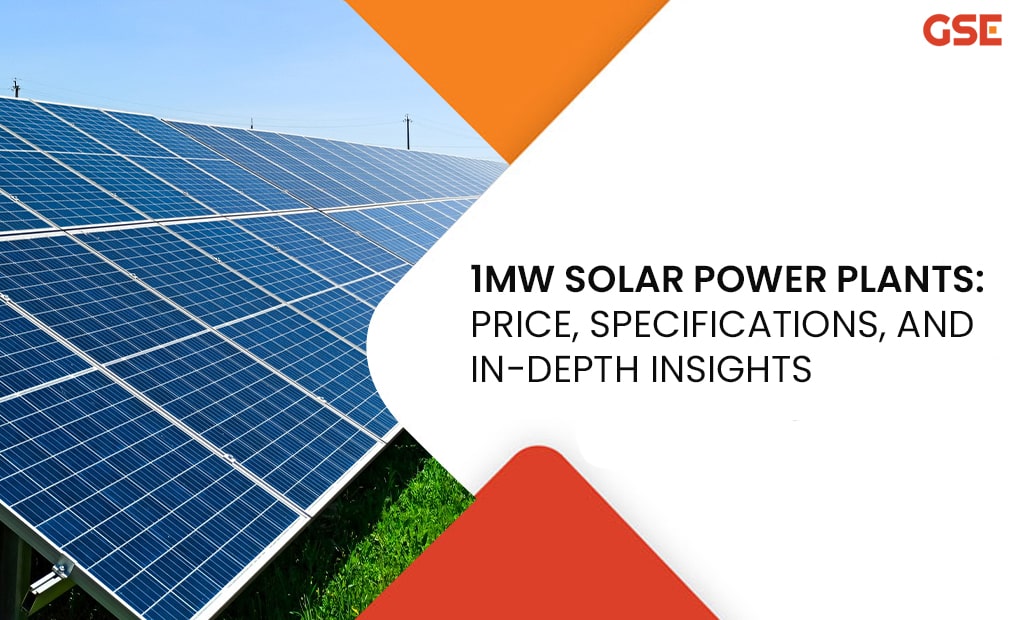
Power systems with capacity of more than 100kW are often called Solar Power Station, Energy Generating Station or Ground Mounted Solar Power Plants. A 1MW solar power plant can be used to supply power to a commercial facility on its own. This area of solar utility farm of about 4 to 5 acres produces about 4,000 kWh of cheap power daily. The most common solution, especially in industrial and commercial sectors, that offers businesses a reliable and cost effective energy solution is the installation of solar power plants, especially the 1 MW systems.
Here, we shall discuss the major features of 1 MW solar power plant in India, its specifications, cost advantage as well as the factors that determine the total cost.
A 1MW solar power plant is not a one-size-fits-all solution. It is specifically designed for businesses and organizations with large and consistent daytime energy demands. Here is a clear breakdown of who should seriously evaluate a 1 MW solar project cost and consider commissioning one:
| Segment | Typical Load Profile | Why 1MW Works |
| Large Manufacturing Units | 500 kW to 1.5 MW continuous draw | Covers most or all of daytime load, reducing grid dependency by 60 to 90 percent |
| Food Processing and Cold Storage | Round-the-clock energy demand | Combined with Open Access Solar, delivers predictable low-cost power |
| Educational Campuses and Hospitals | 8 AM to 6 PM peak consumption | Directly offsets the highest-cost grid units consumed during daylight hours |
| IT Parks and Commercial Complexes | Steady office-hours load | Solar covers air conditioning and lighting loads with near-zero per-unit cost |
| Industrial Estates and Clusters | Shared energy requirement above 1 MW | A Solar Farm Solution can serve multiple units from a single 1 MW installation |
| Agro and Textile Industries | Seasonal but high daytime load | OPEX or PPA model makes it viable without blocking capital expenditure |
If your business falls into any of the above categories, explore the Solar Farm Solution and Ground Mounted Solar service pages to understand how a 1 MW plant can be structured around your specific requirements.
As electricity prices continue to climb and corporations increase their efforts to reduce carbon emissions, India’s transition to solar power is gaining momentum. A 1 MW solar power plant is one of the most sought after capacities amongst the commercial and industrial buyers who can justify a solar power plant to significantly reduce their power bills without a significant land requirement and investment. The typical 1MW of PV installed on the ground needs 4 to 5 acres of land and, depending on where it is installed and how much sunshine it receives, produces about 4,000 to 4,500 units (kWh) of electricity per day. GSE Renewables installs, designs and maintains 1 MW plants for industrial units, commercial buildings and institutional investors across India leveraging the components that are sized and specified based on the load profile and roof/ground conditions of each location.
The operational purpose of solar photovoltaic panels remains constant throughout all commercial applications regardless of a 1MW solar power plant’s cost or design. The photovoltaic system uses solar rays to produce emissions-free solar power. The solar panels contain multiple strings of silicon alloy solar cells that generate electrons through sunlight photons while the electrical field changes. The Photovoltaic Effect generates direct current (DC) through this process.
The generated energy moves through wired systems to reach an inverter which converts it into alternating current (AC) electricity suitable for operating electronic devices and appliances. The installation of solar panels requires exact planning that includes correct wiring alongside proper orientation and panel angle selection. The strategic approach ensures ideal sunlight conditions which maximize the output of solar panels especially during peak sunlight hours thus improving both the cost and profit of 1 MW solar power plants in India.
To install a 1 MW solar power plant in India one needs complete understanding of basic components and their technical specifications. A typical 1 MW solar power system consists of standard elements that include these components.
| Key components | Details |
| Key components | Solar panels, solar mounting structure, solar inverter, solar batteries (optional), the balance of system (cables, fuses, MCBs, and Distribution boxes) |
| Energy output | 4,000 kWh of electricity per day | 1,20,000 kWh per month | 14,40,000 kWh per year |
| Area required | 4 to 5 acres of land is required for 1MW solar plant |
One of the most common questions businesses ask is how much land is required for a 1MW solar power plant. The answer depends on panel technology, mounting type, and layout design. The table below offers a practical guide to land required for 1MW solar power plant setups across different configurations:
| Configuration | Panel Type | Mounting Type | Land Required | Spacing Logic |
| Standard Fixed-Tilt | Polycrystalline 340W | Fixed-Tilt | 4.5 to 5 Acres | Row spacing 2x panel height |
| High-Efficiency Mono | Monocrystalline 400W+ | Fixed-Tilt | 4.0 to 4.5 Acres | Fewer panels, tighter rows |
| Tracker-Mounted | Monocrystalline 400W+ | Single-Axis Tracker | 5.5 to 6 Acres | Wider gaps for tracker arm movement |
| Bifacial Panels | Bifacial Mono 430W+ | Elevated Fixed-Tilt | 4.2 to 4.8 Acres | Elevated for ground reflection gain |
| Compact Urban Layout | Monocrystalline 500W+ | Fixed-Tilt | 3.8 to 4.2 Acres | Optimized for limited land parcels |
In addition to panel rows, land must accommodate access roads, inverter stations, transformers, boundary fencing, and a monitoring room. These structural needs typically add 10 to 15 percent to the gross land area. For detailed layout planning and site feasibility, explore our Ground Mounted Solar service page.
The cost of a 1 MW solar plant in India typically ranges between Rs. 4 to Rs. 5 crores, depending on the quality of components, installation requirements, and additional features. The primary contributor to the 1 megawatt solar power plant cost is the choice of solar panels, with monocrystalline panels offering higher efficiency but also increasing overall expenses compared to polycrystalline options. When evaluating the 1 MW solar power plant cost in India, businesses must consider multiple factors to ensure the system aligns with their energy and financial requirements. Below is a cost breakdown:
| Particulars | Estimated Cost |
| Solar Panels | 3 Crore |
| Solar Inverter | 1 Crore |
| Combiners + Junction Boxes | 20 Lakh |
| Protective Gears Arrangement | 10 Lakh |
| SCADA and Data Logger System | 7 Lakh |
| Land Bank | 5 Acres |
| Erection of Project | 50 Lakh |
| Total Project Cost | 4.87 Cr. (Approx.) |
Note: Please note that the mentioned figures are for illustration purposes only. For accurate solar 1 MW power plant cost and profit in India, consult a professional solar company for a personalized quote based on an on-site assessment.
The 1mw solar project cost is not uniform across India. It varies significantly based on local land prices, grid infrastructure, state-level policy incentives, and logistical factors such as transportation of equipment to project sites. The following table provides an indicative cost range for a 1MW solar power plant cost in India across major states:
| State | EPC Cost Range (Rs. Cr.) | Land Cost (Rs. per Acre) | Key Policy Support | Irradiance (kWh/m2/day) |
| Rajasthan | 4.2 to 5.2 | 5 to 15 Lakh | RPO targets, RRECL incentives | 6.0 to 7.0 |
| Gujarat | 4.3 to 5.4 | 10 to 25 Lakh | GUVNL programs, Open Access | 5.5 to 6.5 |
| Maharashtra | 4.5 to 5.8 | 15 to 40 Lakh | MSEDCL net metering, GEOA | 5.0 to 6.0 |
| Tamil Nadu | 4.4 to 5.5 | 8 to 20 Lakh | TEDA subsidies, Group Captive | 5.5 to 6.2 |
| Karnataka | 4.5 to 5.6 | 12 to 30 Lakh | KREDL Open Access, BESCOM | 5.0 to 5.8 |
| Telangana | 4.4 to 5.5 | 8 to 18 Lakh | TSREDCO, Open Access favourable | 5.5 to 6.0 |
| Punjab | 4.6 to 5.9 | 20 to 50 Lakh | PEDA incentives, Captive model | 4.8 to 5.5 |
| Madhya Pradesh | 4.2 to 5.3 | 4 to 12 Lakh | MPUVNL programs, Solar Park access | 5.5 to 6.5 |
| Chhattisgarh | 4.3 to 5.4 | 3 to 10 Lakh | State captive solar, RPO push | 5.2 to 6.0 |
| Andhra Pradesh | 4.3 to 5.3 | 6 to 16 Lakh | APEPDCL programs, IEX trading | 5.5 to 6.2 |
Note: Land cost is not included in the EPC cost range shown above. Total 1MW solar plant cost including land may be 10 to 30 percent higher depending on the location. For a location-specific cost estimate, visit our Solar Farm Cost guide or contact the GSE Renewables team.
For detailed state-by-state costing and developer support, read the Solar Farm Cost Guide or connect with our project team via the Contact Us page.
The cost of a 1 MW solar power plant depends on multiple factors such as panel type, inverter efficiency, mounting structures, installation charges and additional features like storage or trackers. Understanding these factors helps businesses estimate the actual 1 megawatt solar power plant cost in India.
GSE Renewable Energy installs the two main types of solar power plants using the Photovoltaic Effect, each requiring different components that influence the 1 MW solar power plant cost and profitability in India. You can also explore our Solar Farm Solution for large-scale ground-based configurations.
When planning a 1 MW solar power plant for commercial or industrial use, businesses can choose between two primary investment models: CAPEX (Capital Expenditure) and OPEX/PPA (Operational Expenditure/Power Purchase Agreement). Understanding these options helps determine the most cost-effective and strategic approach based on your energy needs and budget.
Whether opting for ownership under CAPEX or a vendor-managed OPEX/PPA system, both models enable businesses to benefit from clean, sustainable energy, reduce electricity costs, and improve operational efficiency. Selecting the right investment model depends on your budget, energy requirements and long-term sustainability goals.
Understanding 1mw solar financing options is critical before committing to a project. Each model carries different implications for upfront capital, ownership, tax benefits, and long-term cash flow. Here is a comprehensive side-by-side view of the three primary CAPEX vs OPEX solar options, including bank loan financing:
| Parameter | CAPEX (Own) | OPEX / PPA (Lease) | Bank Loan (Debt Financed) |
| Upfront Investment | Full project cost (Rs. 4.5 to 6 Cr) | Nil to minimal | 20 to 30% equity, rest borrowed |
| Ownership | Business owns the plant | Developer owns the plant | Business owns after loan repayment |
| Monthly Outflow | Zero (post setup) | PPA tariff per unit consumed | Loan EMI for 7 to 12 years |
| Tax Benefits | Accelerated depreciation (40%) | Not directly available | Interest deduction + depreciation |
| ROI / Payback | 3 to 5 years typical | Immediate monthly savings | 5 to 8 years with loan servicing |
| Best Suited For | Cash-rich businesses with owned land | Businesses wanting zero capex entry | Businesses with credit access and medium capital |
| Risk Profile | Business bears all operational risk | Developer takes performance risk | Shared between business and lender |
A growing number of commercial and industrial businesses are using bank loan financing to commission a 1 MW solar power plant without depleting working capital reserves. Here is how the structure typically works:
For businesses evaluating Open Access Solar under a loan-financed model, the power savings from avoided grid tariffs are often sufficient to service the loan EMI while still generating net positive cash flow from month one of plant commissioning.
The Indian government supports renewable energy through various initiatives and financial programs which help businesses install 1 MW solar power plants. The government provides financial assistance through subsidies and incentives which decrease startup expenses for businesses transitioning to solar power systems while improving their investment returns. The financial assistance for building a 1 MW solar power plant in India follows this structure:
Setting up a 1MW solar power plant involves a structured sequence of regulatory approvals and on-the-ground activities. Businesses planning a 1 MW solar project cost evaluation should factor in the time and cost of the approval process alongside the engineering and procurement phases. Here is an overview of the typical project journey:
GSE Renewables manages the end-to-end project lifecycle from site feasibility to commissioning and long-term O and M. To discuss your specific project timeline and approval requirements, visit the Solar Farm Solution page or reach us through the Contact Us page.
The successful implementation of unique solutions by GSE Renewables Asset Management resulted in significant benefits for both Integrated Food Park Pvt Ltd (Future Group), the client, and the investor. The consumer, Integrated Food Park Pvt Ltd, experienced an annual benefit of 44 lakhs, while the investor enjoyed a savings of INR 9.5 lakhs on an 85-lakh yearly revenue, representing an 11% increase. Furthermore, the investor was relieved of the hassle of plant maintenance, allowing them to allocate their time and resources more efficiently. This achievement further complements the earlier mentioned project report for a 1MW solar power plant.
Investing in a 1 MW solar power plant offers substantial financial advantages for businesses:
Metric | Estimated Range (1 MW Plant) |
Total investment (CAPEX) | ₹4–5 crore (ground-mounted, standard components) |
Average annual generation | 14.5–16 lakh units (kWh), depending on location & irradiance |
Estimated annual savings/revenue | ₹70 lakh–1 crore (at commercial tariff of ₹7–8/unit) |
Payback period | 5–6 years |
Estimated ROI | 15–18% per year post-payback |
Plant lifespan | 25 years (with performance warranty) |
Phase | Duration | What happens |
Site survey, design & approvals | 30–45 days | Feasibility study, structural design, DISCOM & net-metering applications |
Equipment procurement | 20–30 days | Panels, inverters, mounting structure, cabling sourced and delivered |
Civil & mounting structure work | 20–25 days | Foundation, structure fabrication and erection |
Installation & wiring | 25–35 days | Panel mounting, DC/AC wiring, inverter and switchgear installation |
Testing, commissioning & grid sync | 15–20 days | CEIG inspection, DISCOM sync, performance testing |
A 1 MW plant suits a range of buyers and investors, including:
For investors who prefer a hands-off route,GSE Renewables’ SPV and AIF solar investment structures allow you to invest in scalable solar assets without managing land, construction, or day-to-day operations. Learn more about investing in solar with GSE Renewables.
The 1mw solar plant ROI is among the most attractive in the renewable energy sector. The examples below are based on real-world assumptions for grid-connected 1MW solar plants operating in India under a CAPEX ownership model:
| Scenario | Project Cost (Rs. Cr.) | Annual Generation (MWh) | Annual Revenue (Rs. Lakh) | Payback Period |
| Conservative (North India, Rs. 3/unit) | 5.0 | 1,400 | 42 | ~5 years |
| Moderate (South India, Rs. 4/unit) | 4.8 | 1,500 | 60 | ~4 years |
| Optimistic (West India, Rs. 5/unit) | 4.5 | 1,600 | 80 | ~3 years |
| With Accelerated Depreciation Benefit | 4.8 | 1,500 | 60 + Tax Saving | 2.5 to 3.5 years |
| Open Access (industrial tariff Rs. 6/unit) | 5.2 | 1,450 | 87 | ~3 years |
Generation output from a 1MW solar plant depends on the specific location’s solar irradiance and system performance ratio. Here is an indicative generation estimate based on different regional irradiance levels:
| Region | Irradiance (kWh/m2/day) | Annual Generation (MWh) | CUF (%) | Notes |
| Rajasthan and Gujarat | 5.5 to 7.0 | 1,600 to 2,000 | 18 to 23% | Highest output zones in India |
| Maharashtra and Telangana | 4.8 to 5.8 | 1,400 to 1,700 | 16 to 19% | Strong commercial viability |
| Tamil Nadu and Karnataka | 4.6 to 5.6 | 1,350 to 1,650 | 15 to 19% | Good irradiance with policy support |
| Punjab and Haryana | 4.5 to 5.5 | 1,300 to 1,600 | 15 to 18% | Seasonal variation, strong savings potential |
| Northeast India | 3.5 to 4.5 | 1,050 to 1,350 | 12 to 15% | Lower irradiance, longer payback |
CUF stands for Capacity Utilization Factor and represents the proportion of actual energy generated versus the theoretical maximum over a year. A higher CUF directly improves 1MW solar plant ROI by generating more units from the same capital investment.
For additional context on how a 1MW plant compares with larger utility-scale setups, visit the Solar Farm Solution page or review the Solar Farm Cost guide.
Get a detailed project proposal customized to your site, load profile, and budget. Our team evaluates your requirements and delivers a complete report covering system design, land, generation estimates, ROI, and financing options.
The 1MW solar power plant demonstrates strong potential to generate both profits and success. Organizations that select either CAPEX or OPEX financing models can get access to solar power benefits that lower costs and create green electrical power while advancing sustainable development. The implementation and operation of 1MW solar power plants becomes more efficient through the expert support provided by reputable companies such as GSE Renewables. Through their renewable energy expertise GSE Renewables assists businesses to achieve maximum solar power benefits and guide them toward sustainable profitability. For end-to-end 1MW project delivery, explore the Solar Farm Solution and Ground Mounted Solar pages, or contact the GSE Renewables team to begin your 1MW solar project today.
A 1kW solar system needs an open space of 6 square meters for installation. The installation of 1 megawatt solar panels demands more than 6000 square meters of available space. The required space size depends on both the number of solar panels and the selected mounting system. In practical terms, land required for 1MW solar power plant setups ranges from 4 to 5 acres for standard configurations.
The two financing approaches provide unique benefits to users. Your business can select solar ownership through the CAPEX model when it possesses enough financial resources. The PPA agreement under the OPEX model allows you to pay lower monthly rates through a 10 to 25 year period if upfront payments are not possible. Bank loan financing is a third option that combines ownership benefits with manageable monthly outflows.
The operation and maintenance of a 1MW solar power plant proves to be simpler than most people expect. A basic cleaning kit enables proper maintenance of solar panels through regular cleaning procedures. The panels need to stay free of any buildup to reach their maximum operational efficiency.
A 1 MW solar power plant needs 2,500 high-quality solar panels with 400 watts each for its operation. The exact number of panels depends on which panel wattage system is selected.
The installation of a 1 MW solar power plant in India requires an investment between INR 4.5 crores and INR 6 crores. Solar power plant installation expenses depend on multiple variables including geographical location and solar panel type and installation difficulty and monitoring system and inverter requirements. The 1mw solar power plant cost in India also varies by state, with high-irradiance states like Rajasthan typically offering lower levelized cost of energy.
GSE Renewable Energy provides complete solar solutions that cover the design and installation and maintenance services for 1 MW solar power plants. The plant receives optimized solar installation from GSE experts who guarantee compliance with regulations while delivering enhanced return on investment.
One megawatt of solar power plant capacity produces about 4,000 units daily and 1,20,000 units monthly and 14,40,000 units yearly. Solar power plant production levels differ according to location and weather conditions as well as panel operational efficiency.
Key approvals include electricity department connectivity clearance, CEA or CEIG approval, net metering or open access registration with the state regulator, and local municipal NOC. For open access operations, a power purchase agreement or group captive agreement must also be executed with the distribution company.
The payback period for a 1MW solar plant in India typically ranges from 3 to 5 years under CAPEX ownership. With accelerated depreciation benefits and Open Access tariff savings, payback can be achieved in as little as 2.5 to 3 years in high-irradiance states. After the payback period, the plant generates virtually free electricity for the remaining 20 to 22 years of its operational life.
The plant is installed, monitored, and maintained by GSE Renewables’ in-house technical team, who ensure full compliance with MNRE guidelines, DISCOM regulations, and structural safety codes throughout the project lifecycle, from installation through 25 years of operation.
Our Blogs With a combined experience of over 250 years and the successful management of 30 MW of solar energy projects, GSER offers the most efficient solutions. What Is a Solar Power Purchase Agreement (PPA)? A Simple Guide for Indian Businesses If you’ve sat through...
Read MoreOur Blogs With a combined experience of over 250 years and the successful management of 30 MW of solar energy projects, GSER offers the most efficient solutions. Group Captive Solar: The 26/51 Rule for Industrial Buyers Group captive solar enables two or more industrial consumers...
Read MoreOur Blogs With a combined experience of over 250 years and the successful management of 30 MW of solar energy projects, GSER offers the most efficient solutions. 1 kW Solar Panel Price, Units Per Day and Subsidy in India 2026 In 2026, Indian homes are...
Read More