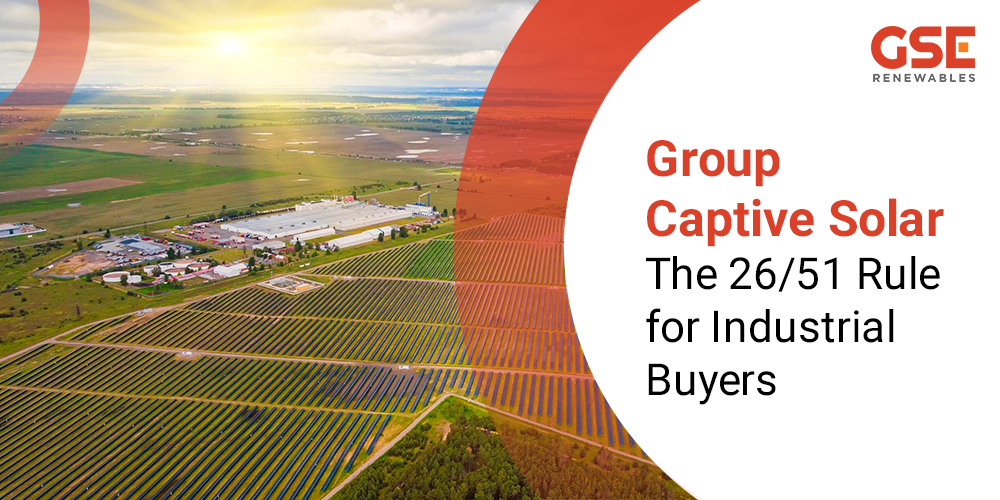
Group captive solar enables two or more industrial consumers to jointly own a solar power plant through a special purpose vehicle (SPV) and use the generated electricity as captive power. Under Rule 3 of the Electricity Rules, 2005, it is important that the captive users have a minimum equity share of 26% in the SPV and must be consuming a minimum of 51% of the total power produced by the plant annually. The 26/51 rule is very important for the captive consumers for exemption from CSS and Additional Surcharge, wherever applicable. For industrial businesses, this structure can provide a more cost-effective way to procure renewable electricity while sharing plant ownership and generation requirements among multiple consumers.
What the 26/51 Rule Actually Says
A collective group of consumers is allowed to establish a generating plant under Section 9 of the Electricity Act, 2003, and use it for the collective benefit of the group. The Electricity Rules, 2005 prescribe that captive users shall jointly hold at least 26% stake in the SPV and the electricity generation from the SPV shall be at least 51% of its annual generation. If both are satisfied, then the plant will qualify as captive generation and hence will be eligible for exemption from Cross Subsidy Surcharge as per applicable regulations. The rules have been amended since the Electricity (Amendment) Rules, 2026, dated 13 March 2026 were notified. The 26% ownership and 51% consumption tests are now assessed collectively rather than proportionally for each member. However, a member’s consumption above 100% to 110% of its proportionate entitlement does not qualify for captive treatment. This makes overall SPV-level compliance the key consideration when structuring a group captive project. For a buyer weighing a group captive structure today, this means the sizing exercise is less about hitting an exact personal ratio and more about ensuring the SPV, as a whole, clears both thresholds every year. Read the full notification on the Ministry of Power’s notifications page.
How the 26/51 Rule Works
Assume that two industrial customers, a manufacturing company and its group logistics and warehousing company, require an 8 MW ground-mounted solar plant. They have agreed to collectively own 30% of the equity of the SPV, which is over the necessary 26% share. The ownership split is 65:35 in line with their planned electricity offtake.
| Member | Share of Member Offtake | Equity Allocation | Approx. Equity Value* |
| Manufacturing Unit (Member A) | 65% | 19.5% | Rs. 6.24 Cr |
| Logistics & Warehousing Arm (Member B) | 35% | 10.5% | Rs. 3.36 Cr |
| Combined Members | 100% of member offtake | 30.0% | Rs. 9.60 Cr |
The remaining 70% equity can be held by a developer or external investor, with captive users’ combined holding of at least 26% portion. From the consumption side, the two members need to collectively consume at least 51% of the plant’s annual generation to stay captive. Both Member A (65%) and Member B (35%) are within their own individual entitlement of 110%. This is an example of how well-equipped equity allocation and consumption planning can be a helping hand in maintaining compliance.
Equity Test vs Consumption Test: The Difference
The 26% equity test is a collective ownership threshold. The group of captive users, as a whole, must hold at least 26% of the SPV. How that 26%, or more, as most SPVs choose to hold a buffer, is split between individual members is a commercial decision, not something the rule prescribes member by member.
The 51% consumption test is also assessed collectively, at the level of the whole SPV, following the 2026 amendment. What has changed is the cap on any one member’s benefit: a member can consume up to 110% of what its equity share entitles it to and still have that consumption count as captive, but anything beyond that ceiling does not receive captive treatment for that member, even while it still contributes to the SPV’s overall 51% figure.
Group Captive Solar vs Captive vs Third-Party Open Access
Group captive is one of three broad ways an industrial consumer can access solar power outside its own rooftop. Here is how it stacks up against the other two, in the same terms used on GSE’s open access solar service page.
| Parameter | Captive Open Access | Group Captive Solar | Third-Party Open Access (PPA) |
| Ownership | Single consumer owns the plant outright | Two or more consumers jointly own the SPV | Developer owns the plant |
| Equity Requirement | None, wholly owned by one user | Collectively at least 26% held by captive users | None |
| Consumption Requirement | At least 51% of generation used by the owner | Collectively at least 51% of generation | None, any volume under the PPA |
| CSS Treatment | Exempt on power self-consumed | Exempt when both thresholds are met | CSS and Additional Surcharge apply in full |
| Best Fit For | Large single-site consumers with enough demand alone | Mid-size consumers whose demand alone will not fill a plant | Buyers who want clean power without capital or SPV effort |
Is Group Captive Solar Right for Your Business
Group captive solar fits businesses with high, stable electricity consumption looking for a lower landed cost than grid or third-party open access power. If the connected load and the monthly DISCOM bills are large enough, it may be worth considering if Cross Subsidy Surcharge (CSS) savings will have a significant impact. It’s also important to be ready to purchase an equity stake in the SPV, and enter into a long-term contract, usually for 15-25 years. It is important to have stable year on year consumption since with captive users the 51% consumption requirement applies on an annual basis. When the demand for the plant is not enough to employ the plant, there is a possibility to link other eligible consumers to achieve the required consumption level and increase the utilization of the plant.
If most of these apply, group captive is worth a serious look. If your demand is too small or too unpredictable to comfortably clear 51% on your own, a group structure with a well-matched partner, or a ground-mounted solar plant under a different ownership model, may be the better starting point. See eligibility from an offtaker’s perspective on GSE’s For Offtakers page.
Not sure where your business fits? Talk to GSE Renewables about whether your site qualifies.
How GSE Renewables Can Help
Setting up a group captive plant touches feasibility, legal structuring, construction, and years of ongoing compliance, and getting any one piece wrong can put the CSS exemption at risk. GSE Renewables supports industrial buyers through feasibility assessment and site-generation matching, commercial and SPV structuring support to help size equity and offtake shares correctly, EPC execution for the plant itself, and ongoing compliance and asset monitoring once it is operational, tracking consumption and equity against the thresholds this article walks through. If you are evaluating whether group captive solar makes sense for your business, GSE Renewables opens with a free feasibility conversation.