What Is a Solar Power Purchase Agreement (PPA)? A Simple Guide for Indian Businesses
Aug 24
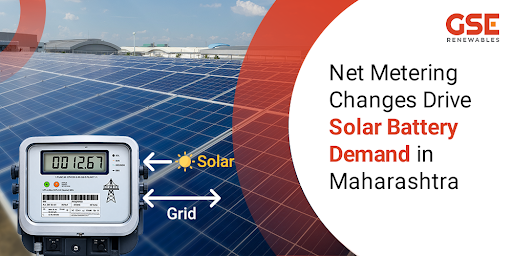
The solar market in Maharashtra has just reached a turning point. Net metering for years has made rooftop solar a safe bet: Generate during the day, sell extra to the grid, get credit for later. That’s a model that is being worn away. MERC has been continually narrowing the windows for net metering exports, shifting more of the largest-size systems to gross billing. This is resulting in an erosion of solar generation economics during the hottest part of the day, in the absence of storage. Coincidently, Maharashtra’s Renewable Energy Policy 2026 also mandated the installation of battery energy storage systems (BESS) and above for new rooftop solar plants with a capacity of 100kW and above. This guide highlights the challenges of solar power Maharashtra and the need for storage to restore the ROI benefits the system provides and how BESS helps overcome this challenge in both commercial, industrial and utility-scale applications.
The Net metering policy in Maharashtra was aimed at a small sized and predictable solar market. Once the rooftop solar capacity levels have increased, the excessive daytime solar generation volume and insufficient production during evening peak load hourshas posed as challenge for grid operators..
MERC has been taking steps to phase out net metering benefits for larger customers. The major modifications impacting Maharashtra solar and battery storage decisions are:
As solar net metering is purely a cost-offset mechanism, the expected financial outcomes are less beneficial today than it was in 2022. A solar plant that generates well on paper is delivering lower bill savings in practice because the value of exported midday units has declined.
A battery energy storage system changes the economics fundamentally. Instead of exporting excess midday generation to the grid at a lower rate, BESS captures that surplus and supplies it when it has the highest financial value: during evening peak demand hours or during grid outages.
The value proposition of BESS in a solar context operates on three levels:
Maharashtra’s Time-of-Day (ToD) tariff structure creates a specific arbitrage opportunity that BESS can systematically utilise to its benefit. Under MERC’s regulated ToD framework, consumers on certain tariff categories pay a premium during designated peak hours and receive a rebate during solar hours.
The typical ToD structure in Maharashtra creates two peak windows per day:
A well-programmed BESS charges from solar generation during midday (solar hours) and discharges strategically into thepeak window, maximising the per-unit financial benefit of stored energy.
Compliance minimum sizing: The 100 kW+ mandate requires BESS capacity of at least 50% of solar kW and a minimum of 2 hours of discharge duration. For a 500 kW solar installation, the compliance minimum is a 250 kW / 500 kWh BESS.
Economics-optimised sizing: For ToD arbitrage and peak shaving, 4-hour duration systems consistently outperform 2-hour systems in financial modelling. This is due to higher available units to setoff in peak zone with other equipment (BoS) remaining the same.
Lithium iron phosphate (LiFePO4) chemistry dominates the Indian C&I BESS market in 2026 — with cycle life exceeding 5,000 cycles, excellent thermal stability in Indian ambient conditions, and strong bankability for project finance.
The surge in interest around solar battery backup systems reflects two converging pressures on industrial and commercial energy consumers in Maharashtra.
The first is grid reliability. Despite significant infrastructure investment, outages remain a reality for manufacturing facilities, hospitals, cold chain operators, and commercial establishments across Maharashtra’s tier-2 and tier-3 cities. Diesel generators have been the traditional answer, but at Rs. 70 to Rs. 80 per litre in 2026, operating costs are severe. A BESS combined with rooftop solar eliminates or dramatically reduces diesel dependency.
The second pressure is net metering erosion. Consumers who installed rooftop solar expecting full retail net metering credits over 25 years are finding that regulatory changes have eroded that assumption. A solar battery backup system transforms stranded midday generation from a low-value export into a high-value, self-consumed asset.
Businesses seeking to understand how solar can most effectively reduce electricity costs should read our guide on how to reduce your electric bill with solar energy.
The challenge with open-access solar is scheduling. Open access consumers must declare forecasted consumption and renewable generation schedules to the SLDC in advance. Deviation incurs Deviation Settlement Mechanism (DSM) charges. An on-site BESS changes this dynamic materially. See our guide on open access solar for large power users in Maharashtra for the full regulatory framework.
The combination of a long-term RE Power Purchase Agreement (PPA) plus on-site BESS is increasingly the structure of choice for large C&I consumers in Maharashtra seeking both cost certainty and grid independence.
For businesses navigating in the MSEDCL jurisdiction, our resource on MSEDCL petitions for solar panel installations and BESS regulations framework from MERC and MSEDCL will provide additional regulatory context.
BESS ROI in Maharashtra comes from multiple stacked value streams. A project that relies on a single revenue source will deliver modest returns. A project that captures demand charge reduction, ToD arbitrage, DG displacement, and improved net metering value simultaneously can achieve payback periods of 5 to 7 years on a 10 to 15 year asset life.
Net metering preservation: Reducing unnecessary exports (which earn low rates) and increasing self-consumption (which avoids peak rate grid purchases).
Harit Urja Nidhi: Maharashtra’s green energy finance fund provides lower-cost project financing for qualifying RE and storage projects.
PLI for BESS manufacturing: The Government of India’s Production Linked Incentive scheme for Advanced Chemistry Cell (ACC) battery storage is driving down domestic battery costs through the 2026 to 2030 period.
Net metering policy in Maharashtra is no longer the reliable, static framework it appeared to be when most commercial and industrial solar plants were designed five years ago. The combination of MERC tightening export credit structures, the 100 kW BESS mandate in Maharashtra’s 2025-2026 to 2035-36 RE Policy, and rising peak demand charges has permanently changed the calculus for solar power in Maharashtra.
A BESS battery energy storage system is the mechanism that restores the original ROI promise of solar, addresses compliance obligations, and positions C&I consumers for the next decade of evolving grid regulations. Whether the driver is DG replacement economics, demand charge reduction, ToD arbitrage, or open access scheduling risk mitigation, the business case for solar and battery storage in Maharashtra is stronger in 2026 than at any previous point.
GSE Renewables designs, supplies, and commissions rooftop solar and BESS systems for commercial and industrial clients across Maharashtra.
Contact GSE Renewables for a Site-Specific BESS Design and ROI Calculation
Yes, for new rooftop solar installations with a capacity greater than 100 kW commissioned from April 2026. Maharashtra’s 2026 Renewable Energy Policy mandates a minimum BESS size of 50% of the solar system’s kW capacity with a minimum 2-hour discharge duration. Systems at or below 100 kW are not currently subject to this mandatory BESS requirement. For example, a 300 kW solar installation requires a minimum 150 kW / 300 kWh BESS. For optimal financial returns from ToD arbitrage, a 4-hour duration system is recommended over the compliance minimum.
Peak shaving refers to the use of a BESS to reduce the maximum power demand a facility draws from the grid during any given measurement interval (typically 15 minutes). DISCOM demand charges are based on this peak draw. By discharging the BESS strategically during the highest-demand periods of the day, consumers reduce their recorded peak demand and therefore their demand charge. Effective peak shaving in Maharashtra can
BESS reduces dependence on net metering by increasing self-consumption of solar generation. Instead of exporting midday surplus at a low gross billing rate, the BESS stores that energy and supplies it to the facility during evening hours, offsetting consumption that would otherwise be billed at the higher peak tariff rate. This converts low-value exported units into high-value self-consumed units, improving overall solar ROI.
Yes. Existing rooftop or open access solar plants can retrofit BESS systems, subject to DISCOMapproval and technical compatibility with the existing electrical infrastructure. Retrofitting may require a hybrid inverter replacement if the current installation uses a standard on-grid inverter. A site assessment and technical feasibility study should precede any retrofit decision.
Under net metering, solar energy exported to the grid earns a credit equal to the full retail tariff rate. Under gross billing, exported units earn only the DISCOM’s approved power purchase cost (APPC), typically 25 to 30% of the retail rate. Gross billing is being progressively applied to larger systems in Maharashtra. BESS mitigates this by reducing the need to export.
BESS projects in Maharashtra that stack multiple value streams, demand charge reduction, ToD arbitrage, DG displacement, and improved solar self-consumption typically achieve payback periods of 5 to 7 years on a 10 to 15-year asset life. Accelerated depreciation of ~40% in Year 1 subject to approval from IT department improves after-tax project economics and reduces the financial payback window. Please check your returns calculations from your expert consultant or CA.
Our engineers will assess your site, model your savings, and provide a no-obligation proposal within 5 working days.
Get Free AssessmentExplore related resources on the GSE Renewables website:
Our Blogs With a combined experience of over 250 years and the successful management of 30 MW of solar energy projects, GSER offers the most efficient solutions. What Is a Solar Power Purchase Agreement (PPA)? A Simple Guide for Indian Businesses If you’ve sat through...
Read MoreOur Blogs With a combined experience of over 250 years and the successful management of 30 MW of solar energy projects, GSER offers the most efficient solutions. Group Captive Solar: The 26/51 Rule for Industrial Buyers Group captive solar enables two or more industrial consumers...
Read MoreOur Blogs With a combined experience of over 250 years and the successful management of 30 MW of solar energy projects, GSER offers the most efficient solutions. 1 kW Solar Panel Price, Units Per Day and Subsidy in India 2026 In 2026, Indian homes are...
Read More