What Is a Solar Power Purchase Agreement (PPA)? A Simple Guide for Indian Businesses
Aug 24
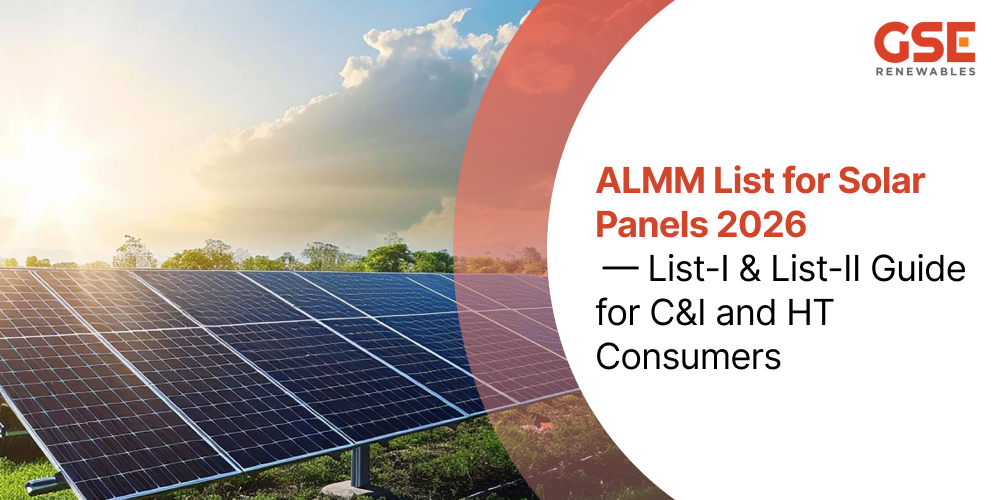
The ALMM list is the quality and origin framework set by the Ministry of New and Renewable Energy (MNRE) that determines which solar panels are eligible for government-linked procurement and subsidy schemes in India. For commercial and industrial (C&I) buyers — whether evaluating a Net metered rooftop system, a ground-mounted plant, or an open access arrangement — ALMM compliance is now a procurement-critical requirement, not just an afterthought.
The rules tightened significantly in June 2026, when ALMM List-II introduced a mandatory domestic cell sourcing requirement. Any C&I buyer entering a new PPA, EPC contract, or open access arrangement after this date must verify that their proposed panels meet both List-I and List-II requirements. This guide explains what ALMM means in a C&I context, what changed in 2026, and what to build into your procurement checklist before signing any solar contract.
The Approved List of Models and Manufacturers (ALMM) is a centralised database maintained by MNRE that specifies which solar panel models and manufacturers have passed India’s quality and compliance standards for PV products.
For all RE power users and consumers, ALMM compliance is relevant across multiple procurement pathways:
Even for purely private C&I installations with no direct subsidy, specifying ALMM-compliant panels is increasingly standard practice for bankability, insurance, and future-proofing against policy-linked resale or refinancing requirements.
The official ALMM list is published on the MNRE website. Here is how to verify a panel model:
For large C&I procurement with multiple panel SKUs across a project, this verification step should be delegated to your technical due diligence team or an independent engineer (IE), not left to the EPC contractor alone.
The ALMM framework now comprises two distinct lists:
| Parameter | ALMM List-I | ALMM List-II |
| What it covers | Approved finished solar panel (module) models | Approved domestic solar cell manufacturers |
| Who must comply | Module manufacturers and their supply chain | Domestic cell manufacturers supplying to module makers |
| Maintained by | MNRE | MNRE |
| Effective from | Ongoing (pre-existing requirement) | June 1, 2026 (new enforcement) |
| Relevance to C&I buyer | Direct: the panel model specified in your EPC contract must be on List-I | Indirect but binding: your List-I panel must use cells from a List-II certified manufacturer |
For a C&I buyer reviewing an EPC proposal or PPA term sheet, both lists are now simultaneously relevant. A panel that appears on List-I but uses imported cells from a non-certified source loses its subsidy and scheme eligibility from 1st June 2026 onwards.
ALMM List-II is a direct enforcement mechanism for India’s Domestic Content Requirement (DCR) policy. For several years, a large share of the solar cells used inside panels manufactured by Indian module makers were imported from China. ALMM List-II closes this gap by restricting scheme-eligible panels to those using cells sourced exclusively from MNRE-certified domestic manufacturers.
As of May 2026, MNRE has approved approximately 30 GW of domestic solar cell manufacturing capacity under List-II. Approved manufacturers include Adani Solar, Waaree Energies, Reliance New Energy (HJT cells), RenewSys (TOPCon cells), and Jupiter Solartech, among others.
The List-II enforcement was deferred multiple times after its initial announcement in 2023. The June 1, 2026 date is the confirmed enforcement deadline, and MNRE has signalled no further postponement. C&I buyers with projects in procurement or under EPC negotiation should treat this deadline as fixed when building project timelines.
ALMM Compliance in C&I Procurement: The Risk Chain
C&I solar projects involve larger capital commitments, longer contract tenures, and more complex regulatory touchpoints. The consequences of ALMM non-compliance are proportionally more significant:
Before executing any C&I solar agreement, ensure the following are addressed in writing:
Not all C&I projects are subject to the June 2026 enforcement:
Exempt:
Not exempt:
C&I buyers with legacy projects already commissioned are unaffected. Those in active procurement or under EPC negotiation for new capacity must assume full List-II compliance is required.
For a detailed breakdown of open access compliance at the commercial and industrial scale, see our guide on open access solar in Maharashtra.
With approximately 30 GW of List-II certified cell manufacturing capacity already operational by mid-2026, there is no meaningful supply constraint affecting the C&I market.
For utility-scale and large C&I projects, the incremental cost impact of List-II compliance is estimated at under ~15-25% of total EPC cost, well within normal procurement variance.
The more material cost risk for C&I buyers is not List-II compliance itself, but panel de-listing during project execution, which is a timeline and contract management issue, not a supply pricing issue.
ALMM compliance is a procurement-critical issue for any consumer entering a new solar arrangement in 2026. The framework now has two layers viz. List-I for the finished panel, List-II for the cells inside it and both must be verified before contract execution, not after commissioning.
The financial and regulatory exposure from non-compliance at the C&I scale is significant: disqualified incentives, open access complications, EPC contract disputes, and stranded project financing. A 30-minute verification exercise at the procurement stage eliminates most of this risk.
GSE Renewables supplies and installs only ALMM List-I compliant panels using List-II certified cell inputs across all C&I and HT project categories. Contact us for a technical assessment, ALMM compliance verification, and a project-specific proposal.
The ALMM list (Approved List of Models and Manufacturers) is a quality and compliance registry maintained by MNRE. For C&I buyers, it determines which panel models are eligible for use in government-linked schemes, DISCOM-approved installations, open access projects, and PSU tenders. Non-compliant panels can disqualify a project from incentives, approvals, or financing.
Visit mnre.gov.in, download the latest ALMM List-I revision, and cross-check the manufacturer name and exact model number for every panel SKU proposed in your EPC contract. For large projects, this verification should be carried out by your independent engineer, not delegated to the EPC contractor.
ALMM List-II is a registry of approved domestic solar cell manufacturers. From June 1, 2026, any module to be used in a scheme-eligible or DISCOM-approved project must be manufactured using cells from List-II certified suppliers. This affects new EPC contracts, open access generation-side approvals, and PSU tenders.
Yes, for any open access project commissioned after June 1, 2026. Projects commissioned before that date, and those with bid submission on or before August 31, 2025, are exempt.
At minimum: a warranty of current List-I status with revision reference, a List-II cell sourcing confirmation, a de-listing indemnity clause obligating the contractor to substitute non-compliant panels at no cost, and a buyer right to independent verification at the point of panel delivery.
Approved List-II cell manufacturers include Adani Solar, Waaree Energies, Reliance New Energy (HJT cells), RenewSys (TOPCon cells), and Jupiter Solartech, among others. Total approved domestic cell capacity stands at approximately 30 GW as of mid-2026.
The panel loses its scheme eligibility. The risk and cost of replacement should be pre-allocated in the EPC contract via a de-listing indemnity clause. Without this clause, the buyer may bear the cost of panel substitution or face delayed commissioning.
Our engineers will assess your site, model your savings, and provide a no-obligation proposal within 5 working days.
Get Free AssessmentExplore related resources on the GSE Renewables website:
Our Blogs With a combined experience of over 250 years and the successful management of 30 MW of solar energy projects, GSER offers the most efficient solutions. What Is a Solar Power Purchase Agreement (PPA)? A Simple Guide for Indian Businesses If you’ve sat through...
Read MoreOur Blogs With a combined experience of over 250 years and the successful management of 30 MW of solar energy projects, GSER offers the most efficient solutions. Group Captive Solar: The 26/51 Rule for Industrial Buyers Group captive solar enables two or more industrial consumers...
Read MoreOur Blogs With a combined experience of over 250 years and the successful management of 30 MW of solar energy projects, GSER offers the most efficient solutions. 1 kW Solar Panel Price, Units Per Day and Subsidy in India 2026 In 2026, Indian homes are...
Read More