What Is a Solar Power Purchase Agreement (PPA)? A Simple Guide for Indian Businesses
Aug 24
Considering the change to solar power but not sure which one will fit you the best? First of all, it is worth clearing the confusion between on grid and off grid solar systems: the two primary systems that power homes, businesses and industries all throughout India.
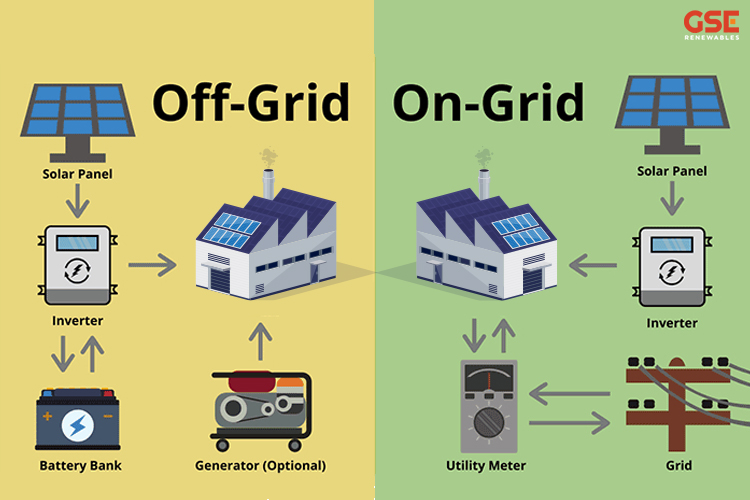
On grid solar system is a type of solar system that is directly connected to electricity grid in the area. It enables you to utilize solar energy throughout the day and export any additional power under the net metering system which assists you save a lot of money in paying electricity bills. The system is best suited to a city and a commercial structure that has a dependable grid connection.
Conversely, an off grid solar power system is not dependent on the utility grid. It keeps the power produced by the solar panels in batteries, which supply constant power when there is an outage or when there are no power outlets. It is an ideal fit in the countryside, farms, or industries that require self-sufficiency in energy and power.
In deciding whether to install on or off grid solar systems, you should ensure that you put into consideration your energy consumption, geographical location, and future aspirations. On grid systems are cheaper and have quicker payback period whereas off grid systems allow you to have the full control of your energy supply.
Here you will find out the functionality of each system, their benefits, prices, and suggested uses – to determine the best solar solution to your energy requirements and sustainability objectives.
An on-grid solar power system is a system that uses solar power to supplement the main electricity grid and ensure a reliable supply of energy at a very cheap rate. The process is to be executed in the following steps:
1 Solar Panels: Photovoltaic (PV) panels absorb the sunlight and transform it into direct current (DC) electric power. Such panels are normally fitted on rooftops or an open area where the sun is exposed most.
2. Inverter: The DC power emitted by the panels is fed to an inverter that is used to convert it to alternating current (AC) electricity- the format used by household and commercial appliances.
3. Electrical Service Panel: The transformed AC power is supplied to the main circuit of the building where power is supplied to all the appliances and equipments connected to it.
4. Net Metering: The remaining unused electricity is back fed to the grid through a net meter with two directions. This meter records the energy being imported as well as exported and users can earn credits or save on their electricity bills. The policies of net metering are not the same in all states.
5. Grid Backup: When there is a lack of solar production like at nighttime or on rainy days, the system will automatically switch to the grid power supply hence maintaining constant power supply.
1. Seamless Grid Integration:
On-grid systems are linked directly to the local electricity grid, which is a virtual battery.This saves the cost of having costly energy storage systems and also guarantees uninterrupted power supply.
2.Earn with Net Metering:
The excess solar power which is produced during the day can be returned to the grid.With net metering programs, this excess power is given credits or payments to the users which reduces the energy bills and enhances ROI.(Note: Net metering policies can be state-specific)
3.Reliable Power Supply:
These systems also provide a constant power supply even when the sun is not shining, that is even at night because they have a stable connection to the grid so that your operations will not experience downtimes.
4.Cost-Effective Installation:
On-grid systems do not need batteries which means that their cost of installation is substantially less than off-grid systems.This renders them an easy and cost-effective alternative in commercial and industrial purposes.
An off grid solar system is a system that does not rely on the utility grid to supply electricity, but produces its own power and stores it as a battery bank using solar panels and battery banks. It is a solution-based all-encompassing energy system that targets remote locations or off-grid locations. A typical off grid system of solar power has been known to incorporate solar panels, inverters, charge controllers, and energy storage batteries that are integrated to bring about a stable source of power. Using solar energy, such systems do not rely on the conventional sources of power and allow people to live clean and sustainable even in the off-grid areas.
An off grid solar power plant can scale from small residential setups to large commercial installations, offering complete energy independence and reliability even in harsh or remote environments.
On-Grid vs Off-Grid Solar: Compare and Find the Right Solution to Your Business.
1. Connection: Solar systems which are used on-grids are connected to the utility grid and excess energy may be exported on a net metering basis. Solar systems without grid connections have batteries and are therefore self-sufficient to provide complete autonomy of energy.
2. Cost: On-grid systems are cheaper because of the use of no batteries, and off-grid systems are expensive in terms of energy storage.
3. Energy Reliability: On-grid guarantees stable power supplied by the grid, which is suitable in businesses in the urban areas. Off-grid is fully independent and ideal when in remote or prone to outages locations.
| Aspect | On-grid Solar system | Off-grid Solar System |
|---|---|---|
| Definition | An on-grid solar system is connected to the electricity grid, exporting surplus power when available | An off-grid solar system operates independently of the utility grid, storing surplus energy in batteries for use |
| Connection | Connected to the local electricity grid, allowing for the export of surplus energy and import during shortages. | Operates independently from the grid, relying solely on solar panels and battery storage for power. |
| Energy Storage | Typically, does not require batteries; excess energy is fed back to the grid, often through *net metering. The application of net metering changes as per the state policy. | Requires batteries to store excess energy for use during periods without sunlight. |
| Cost | Generally lower initial costs due to the absence of batteries; potential savings through *net metering. The application of net metering changes as per the state policy. | Includes the cost of the battery, which may need to be replaced once its lifespan has ended. However, it eliminates monthly electricity bills |
| Maintenance | Lower maintenance cost, as it primarily involves cleaning of solar panels. | Higher maintenance due to battery upkeep; batteries may need replacement over time. |
| Ideal For | Areas with reliable grid access; users looking to reduce electricity bills without complete energy independence. | Remote locations without grid access; individuals seeking full energy autonomy. |
When choosing an appropriate solar solution for your business, there are a number of important factors to be considered:
GSE Renewables (GSER) is the company that provides on-grid and off-grid solar solutions on a commercial scale in India. We enable businesses and industries to have valid and cost-efficient solar power with maximum ROI and minimum risk involved by enabling them to have feasibility and financing, installation, monitoring and lifecycle support.
Yes, but it requires additional battery storage and inverter upgrades to ensure uninterrupted power.
Excess electricity is fed back to the grid, providing credits that reduce monthly electricity bills.
Regular inspection of batteries, inverters, and panels ensures reliability and efficiency.
No, battery storage is essential to provide electricity when solar generation is insufficient.
The three main types of solar energy systems are:
The key difference is how they manage electricity:
On-Grid Solar Systems reproduce the surplus energy into the grid and use the grid to supply backup power. Off-Grid Solar Systems are made to be independent with batteries to store energy providing the entire energy freedom, but with a need to manage the battery.
Off-grid solar systems have batteries that typically have a duration of 515 years, depending on the type, quality, and maintenance. Battery life may be increased by regular maintenance and proper use, although replacement costs need to be part of long-term planning.
On-grid systems ensure reliable supply of electricity at night because they will take power off the grid when there is a lack of solar production. This guarantees continuous power supply to homes or businesses during the low sun rays or on cloudy days.
Our Blogs With a combined experience of over 250 years and the successful management of 30 MW of solar energy projects, GSER offers the most efficient solutions. What Is a Solar Power Purchase Agreement (PPA)? A Simple Guide for Indian Businesses If you’ve sat through...
Read MoreOur Blogs With a combined experience of over 250 years and the successful management of 30 MW of solar energy projects, GSER offers the most efficient solutions. Group Captive Solar: The 26/51 Rule for Industrial Buyers Group captive solar enables two or more industrial consumers...
Read MoreOur Blogs With a combined experience of over 250 years and the successful management of 30 MW of solar energy projects, GSER offers the most efficient solutions. 1 kW Solar Panel Price, Units Per Day and Subsidy in India 2026 In 2026, Indian homes are...
Read More